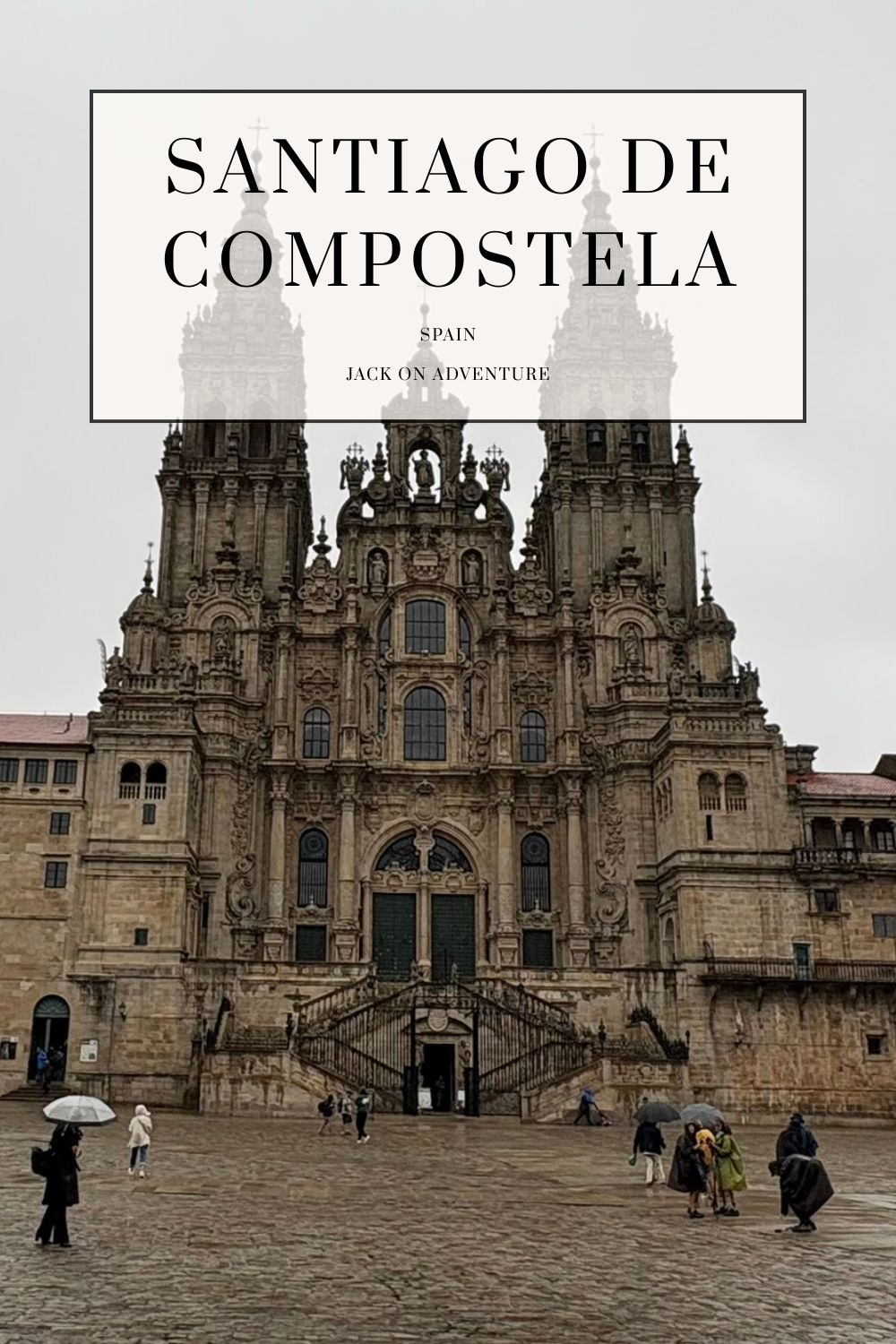
Nestled in the Galicia region of northwestern Spain, Santiago de Compostela is home to the magnificent Cathedral and many beautiful ancient sites. The city is known as the burial site of Apostle St. James, kept safe inside the Cathedral. The history dates back to the 9th century when the apostle’s tomb and his relics were rediscovered in 820 AD. The Old Town was designated as a UNESCO World Heritage Site in 1985.
Santiago de Compostela marks the traditional end for many pilgrims who have embarked on the Christian pilgrimage on the Way of St. James. Almost 500,000 pilgrims and hikers walk the Camino into Santiago, plus countless tour groups arrive here to catch a glimpse of the beautiful architecture.
Brief History of Santiago de Compostela
Saint James the Great, the son of Zebedee and Mary Salome, is one of the first disciples to join Jesus. He and his brother, Saint John the Evangelist, were summoned by Jesus when fishing in the Sea of Galilee. Jesus called them Boanerges (Son of Thunder) due to their impulsive nature.
Saint James was part of Jesus’ inner circle of Apostles, together with John and Peter. They were with Jesus during some of the important events: the raising of Jairus’ daughter, the Transfiguration on Mount Tabor and the prayer in the Garden of Gethsemane.
When Saint James returned to Judea, he was beheaded by order of King Herod Agrippa in 44 AD. His disciples, Athanasius and Theodore, collected his body, embarked with it on a ship and carried it miraculously by sea to Iria Flavia. His remains were buried in secret, and his tomb was forgotten for centuries.
The tomb was rediscovered in 814 AD by Pelagius the Hermit after he witnessed mysterious lights in the night sky above the Libredón forest. Bishop Theodomirus of Iria recognized it as a miracle and informed King Alfonso II of Asturias and Galicia. Then the king ordered to build a modest church on the site in 834 to honor the Apostle and his relic.
The Jacobean Route of the Compostela is the only route that was traveled in the same way in ancient times. It is believed that the king was the first pilgrim to this shrine. The first church was constructed in 829 AD and later rebuilt in 899 AD under the reign of King Alfonso III of León. The location soon became a major pilgrimage destination, with word spreading across Christian Europe.
The city was later named Santiago de Compostela. The name derives from the Latin Sanctus Iacobus (Saint James) and Compostela, likely from Campus Stellae, meaning “Field of Stars,” a reference to the miraculous light that revealed the tomb. It is one of the three great pilgrimage sites of Christendom, alongside Rome and Jerusalem.
The scallop shell, often found on Galician beaches, became the symbol of the pilgrimage. Today, it is worn by pilgrims who walk the Camino de Santiago, a spiritual journey leading to the resting place of Saint James. He is the patron saint of Spain.
Best Time to Visit
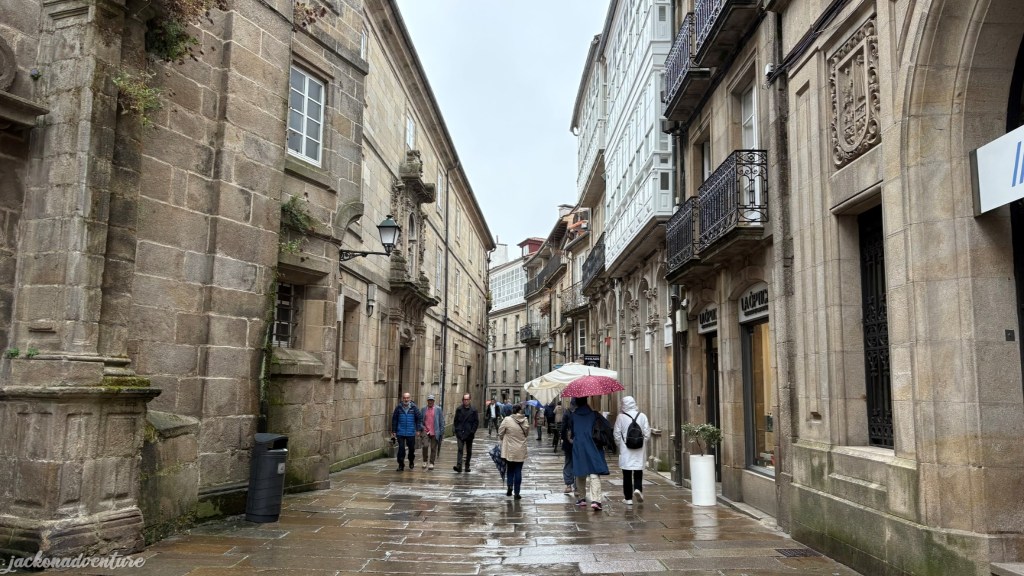
The vast majority of pilgrimages take place between April and October, when the weather is ideal. If you are not walking the Camino, then you can go there throughout the year, but it’s best to visit when the weather is pleasant.
The spring between March and May is among the best times to visit the city. Some rainfall can be expected, which makes the weather cooler and comfortable for walking. Autumn, from September to November, is also a great time to visit. Both seasons are ideal to visit and there are fewer crowds.
The most popular months for pilgrims to walk the Camino are from June to August. These are the hottest months of the year. Summer is the peak season and is often overcrowded. In addition, many tourists visit in July, especially on July 25 when locals celebrate the day of Santiago de Compostela’s patron saint. It is best to book the flight and accommodation well in advance.
Winter in Galicia lasts from December to February. It is relatively mild, but it can be fairly cloudy, rainy and windy. Many pilgrims avoid walking the Camino during the winter because the weather can be cold and many albergues are closed along the coastline and in the highlands.
Getting There
By Plane
Santiago-Rosalía de Castro Airport (Airport Code: SCQ) serves as the main gateway to Santiago de Compostela and is located 15 kilometers away from the historic city center. Most flights are mainly from Spain, with only a limited flights from other parts of Europe.
Bus Line 6A operated by Tussa runs every 20- 30 minutes daily from 7 am to 11 pm and takes around 35 minutes to reach Praza de Galicia in the city center. A one-way ticket costs €1 and is paid directly to the bus driver. Other options for getting to the city center include taking either Uber, Bolt or a taxi if you have a lot of baggage to carry.
By Train
Santiago de Compostela Railway Station is located only 1.5 kilometers from the city center. You can take the high-speed train from major cities in Spain. The journey from Barcelona takes around 8 hours and the train from Madrid takes 5 hours. Taxis are available outside the train station or you can hail Uber or Bolt to get to the accommodation.
By Bus
Traveling to Santiago de Compostela by bus is the cheapest option. Flixbus and Spain’s national bus company ALSA, run through many cities around Spain and Portugal. The bus terminal is also located relatively close to the city center.
I enjoyed my 3-hour bus ride with ALSA bus from Santiago de Compostela to Porto after completing my Camino Portugués without any hassle. The bus service is very reliable and punctual, and the seating is clean and comfortable.
Getting Around
With all historical sites concentrated in the heart of the city, the best way to get around Santiago de Compostela is on foot. The Old Town is compact and highly walkable with pedestrian-friendly streets that allow you to wander around without any vehicles.
The Cathedral is located in the city center, and you can easily navigate from there. Many historic buildings are situated close to the cathedral.
The Best Activities for 2 days in Santiago de Compostela
Despite being a relatively compact city, Santiago de Compostela has many interesting historic landmarks to visit. Assuming you’ve completed the pilgrimage early in the morning or arrived yesterday, you can make your way to Praza do Obradoiro as your starting point to discover the secrets of Santiago.
Exploring the city at one’s own pace offers a more personal and reflective experience. Spending 2 days in the city is more than enough to see the popular sites. Keep reading and I will share with you how to experience Santiago to the fullest.
Step into the Praza do Obradoiro


If you’re walking on the Camino and have made it to the main square of Santiago de Compostela. Congratulations and the city welcomes you on your arrival.
After completing on one of the Camino routes, you will reach the final steps and gather at Praza do Obradoiro with other pilgrims to celebrate the mixture of joy, pain and relief. There is a stone slab in the center that reads ‘Kilometer Zero’ on the trail to mark the end of the long journey.
At this moment, pilgrims gather here, holding hands in prayer, lying on the ground with their shoes removed and admire and take photos of the stunning Cathedral.
If you come here on July 24th, the locals will flock to the square to celebrate St James Day and enjoy the fireworks.
Visit the stunning Santiago de Compostela Cathedral
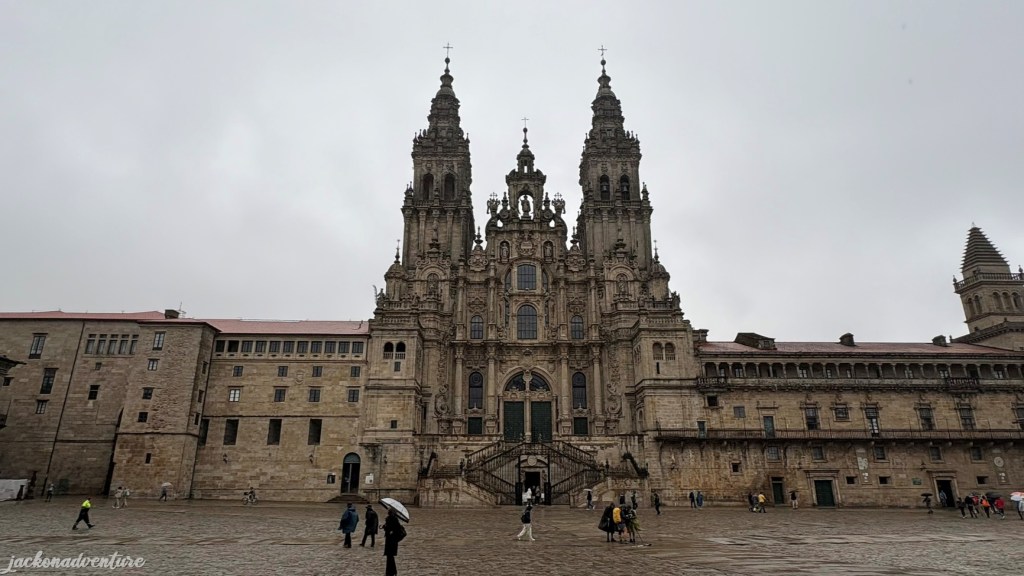
The Cathedral of Santiago de Compostela is magnificent in so many ways.
The Romanesque cathedral is a mandatory stop in the city. It is the burial site of Saint James the Great, one of the apostles of Jesus Christ. Thousands of pilgrims from all over the world make their journey through the Camino de Santiago to this final destination every year.
There were bloody wars between Christians and Muslims. The early church was completely destroyed by fire by the Arabs in 997. Fortunately, the tomb and relics were left undisturbed. The borders were eventually solidified and the routes were formalized in the 10th century.
The present cathedral was built between 1075 and 1128 under the reign of Alfonso VI of Castile and the patronage of Bishop Diego Peláez. Little changes were made over the centuries until the 18th century, when Gothic and Baroque style elements were added.
The entire city was built around the holy site, which still holds the remains of St. James under the exquisite Baroque altar. The cathedral is one of only three known churches built over the remains of an apostle (The other two being St. Peter’s Basilica in Vatican City and St. Thomas Cathedral Basilica in Chennai, India).
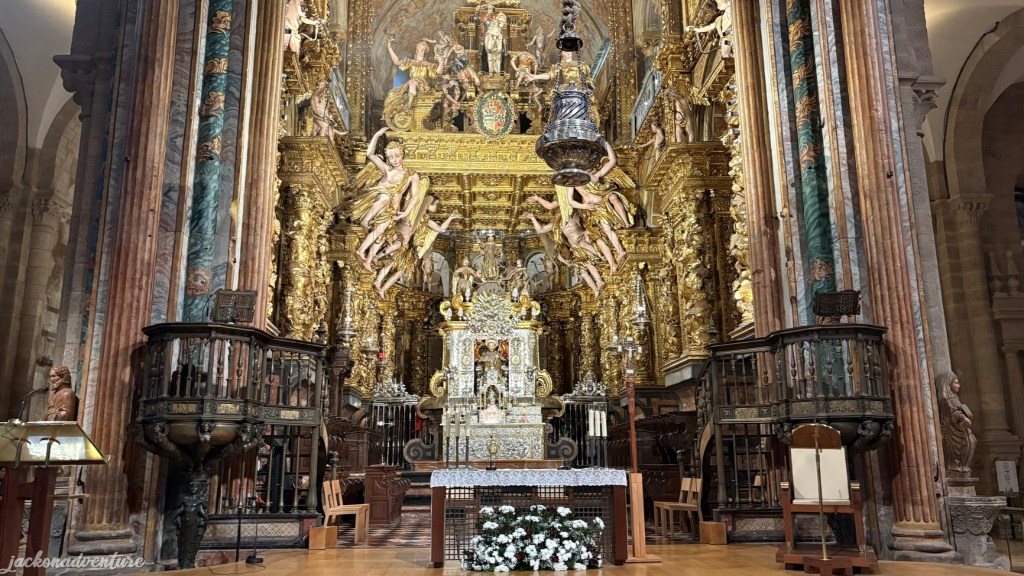
You can attend the Mass with other pilgrims, which is held daily at 7 am, 9.30 am, 12 pm and 7.30 pm. The Mass typically lasts for 45 minutes, and you can witness the Botafumerio Ceremony ipfront if you are lucky. The Botafumero is carried and swung by eight men dressed in red robes. The tradition of using the swinging censer originated in the 11th century for the arriving pilgrims who were tired and unwashed. It is believed that the incense smoke had a prophylactic effect during the periods of plagues and epidemics.
Location: Praza do Obradoiro, s/n, 15704 Santiago de Compostela, A Coruña
Opening Hours: Daily from 7 am to 9 pm
Entrance Fee: Free
Admire Pórtico da Gloria
Located at the western entrance of the Cathedral, the Pórtico Da Gloria is home to over 200 Romanesque sculptures crafted by Mastro Mateo in 1168. This was his life’s work as the gate was completed in 1211, only six years before he died.
Mateo combined French, Italian and Spanish influences to create this exquisite door adorned with granite sculptures. He aims to inspire an apocalyptic scene focused on the vision of the celestial Jerusalem, completing the history of salvation of Man, making visitors feel humbled and enlightened.
A representation of Saint James appeared at the centre, seated on a throne and holding the crosier of the archbishops of Compostela. The column bears the Latin words “Misit me Dominus,” which translates as “The Lord sent me.”
The central tympanum of the Glory is dominated by an image of Christ in Majesty, surrounded by the four evangelists and the group of the blessed. The angels with instruments of the Passion are represented in the lower part, and, in the archivolt, twenty-four elders tune their instruments to play celestial music.
The left arch represents the People of Israel abiding by the Mosaic law. The lower arch is the descent of Christ into Limbo after his death. The Final Judgment is depicted in the right arch with the heads of Christ and Saint Michael in the keystone, lead to Glory from the damned, who are placed under torment.
Other features of the Portico include bears, wolves, lions and fantastical animals of the medieval bestiary as potential symbols of oppressed evil by the Glory of God. Master Mateo is also represented at the foot of the Portico of Glory, a portrait of humility, has been “canonized” under the name of Santo dos Croques.
Travel Tips: Unfortunately, photography within the Pórtico Da Gloria is prohibited and 15 minutes is allowed to view the Glory.
Opening Hours: Monday to Friday: 10 am to 8 pm
Entrance Fee: Adults: €15/ Adults aged 65+ and Visitors with Disabilities: €12/ Children below 12: €12
Admire the Raxoi Palace
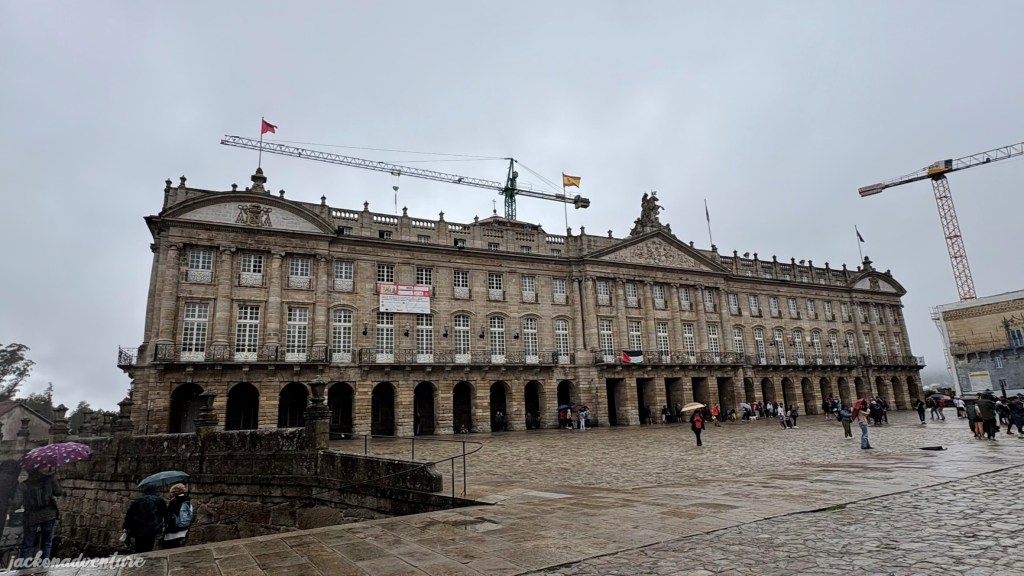
Situated in front of the west façade of the Cathedral, the majestic Paxoi Palace (Pazo de Raxoi) was built in the 18th century by order of Archbishop Bartolomé Raxoi Losada. It was originally the residence of the choirboys, acolytes and priests. The palace was also once used as a jail and town hall.
The palace currently serves as the headquarters of the City Council of Santiago de Compostela and the Presidency of the Autonomous Government. It stands as a symbol of governance and tradition, serving as a constant reminder of Galicia’s rich cultural and political heritage.
You can walk around the exterior areas of the palace to admire the façade and appreciate the architectural beauty. The space between the building’s columns offers one of the best vantage points to capture incredible views of the Cathedral.
Location: Praza do Obradoiro, 15705 Santiago de Compostela
Take a glimpse of the Monastery of San Paio de Antealtares
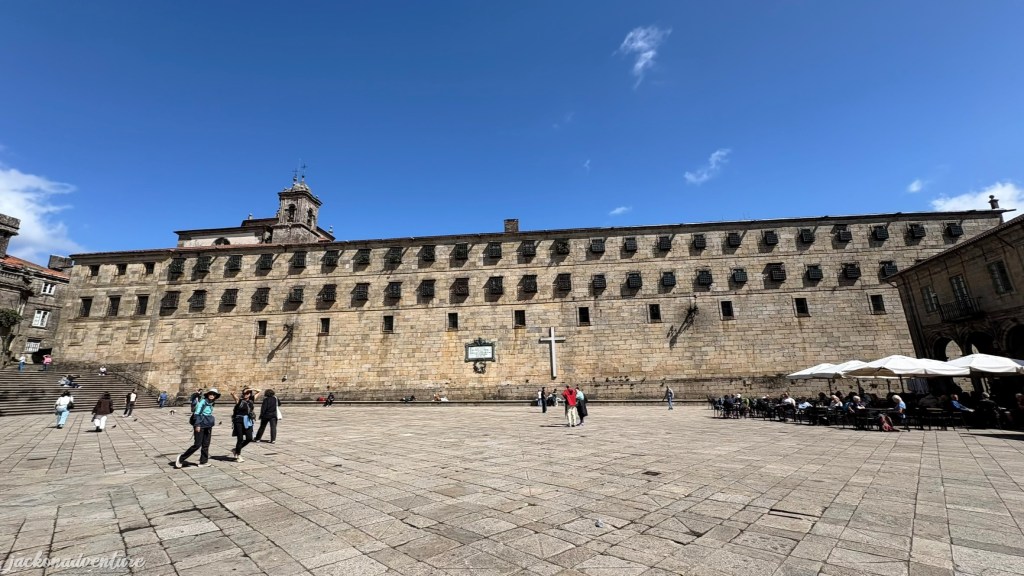
The Monastery of San Paio de Antealtares was founded in the 11th century by Alfonso II with 12 Benedictine monks. They were entrusted with the care and worship of the recently discovered tomb of the Apostle James.
After the Benedictine monks left in 1499, the monastery was occupied by cloistered nuns. The convent was dedicated to Saint Pelayo, who was martyred as a child in Córdoba. An image of his martyrdom dominates the church façade.
The present church dates entirely to the 17th and 18th centuries, following the demolition of the original structure. In the center of the unadorned walls, a stone plaque commemorates the formation of the Literary Battalion, organized by Compostela’s university students to defend Galicia against Napoleon’s troops.
The nuns still live in the monastery and they sell a variety of baked goods, including the city’s famed Tarta de Santiago. Although I didn’t visit the Museum of Sacred Art inside the monastery, it houses the original altar that once accompanied the apostolic sarcophagus. It was given to the convent by Xelmírez, who replaced it with a more magnificent one inside the Cathedral.
Location: Praza da Quintana de Vivos, Santiago de Compostela, A Coruña
Entrance Fee: Free
Meander around Praza da Quintana de Mortos
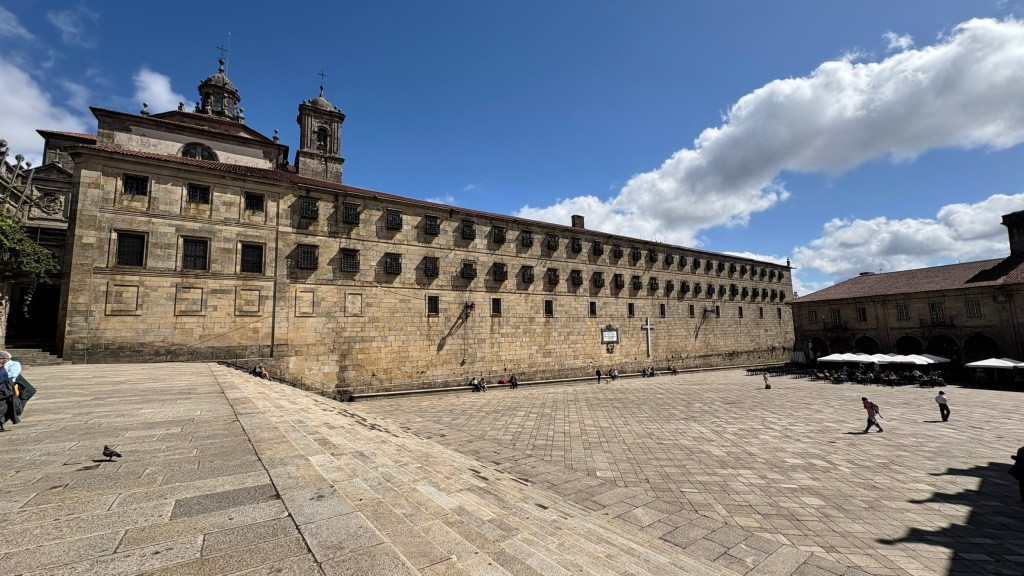
Located in front of the Monastery of San Paio de Antealtares lies the expansive Quintana Square. It is divided into two sections: Quintana de Mortos and Quintana de Vivos.
The Quintana de Mortos, known as ‘Quintana of the Dead’, was once a medieval cemetery until the late 18th century. Quintana de Vivos, or ‘Quintana of the Living’, occupies the higher level of the square.
The impressive Clock Tower stands at the corner of the Cathedral. It was decorated with 24 Romanesque biblical sculptures at the top that were created by Maestro Mateo in the 12th century.
Also located here is the Holy Door, which opens only during special events, such as Jubilee Years. The door, known as the Porta Santa or the Puerta del Perdon (the Forgiveness Door), is one of the most symbolic entrances to the cathedral.. It takes pilgrims straight into St James’ Crypt under the main altar.
Location: Praza da Quintana de Vivos, Santiago de Compostela, A Coruña
Walk through Plaza de las Platerias
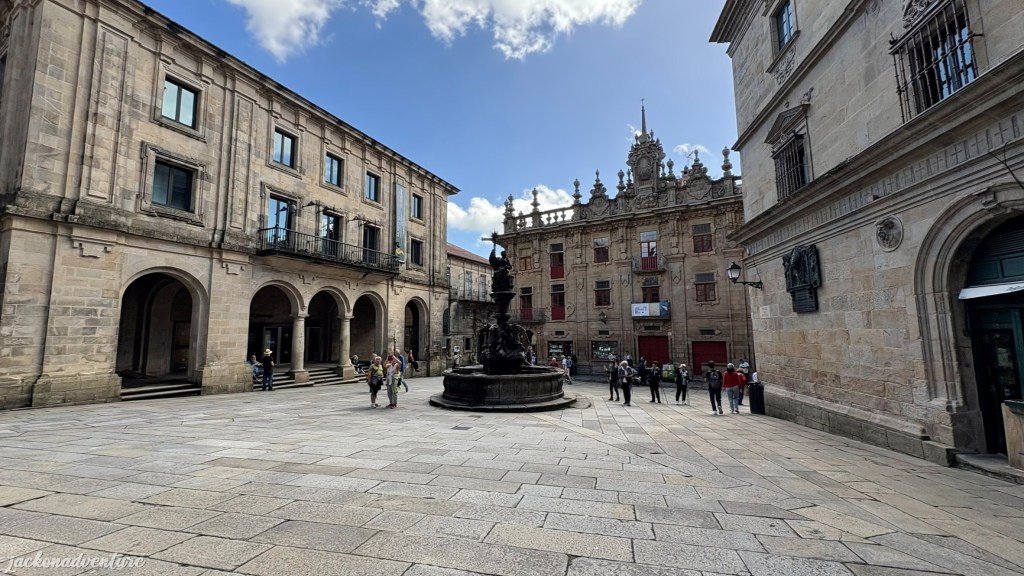
The Plaza de las Platerias, located to the south of the Cathedral, was translated as the “Square of the Silversmiths.” The silversmith workshops that dominated the Cathedral’s only remaining Romanesque façade had occupied the arches underneath the cloister during the Middle Ages. It dates from the year 1078 or 1103 and was severely damaged during the popular uprisings against Archbishop Gelmírez. The restoration was carried out in the 12th century.
At the centre of the square, the Fuente de los Caballos (Fountain of the Horses) rises against the background of the Casa del Cabildo. The Boraque-style fountain is adorned with geometrical motifs depicting four sea horses.
Visit the Museum of Pilgrimage
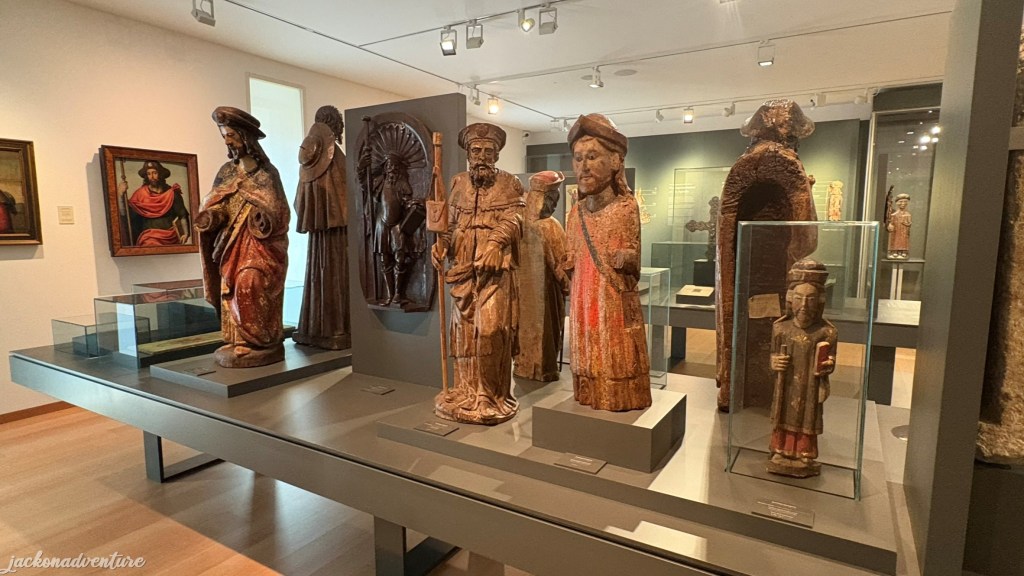
The Museum of Pilgrimage (Museo das Peregrinacións e de Santiago) takes you through the life of Saint James and other Apostles who walked with Jesus Christ and where they are believed to be buried, as described in ancient texts, legends, and traditions. The exhibits also showcase 7 different Camino trails across Europe that lead to Santiago de Compostela, emphasizing the significance of pilgrimages within the Christian world, including Jerusalem and Rome.
According to ancient texts and legends, Saint James was said to have preached in Hispania, which is now modern-day Portugal and Spain. Many artifacts, statues and religious pieces are displayed in the museum.
Location: Praza das Praterías, 2, 15704 Santiago de Compostela
Opening Hours: Tuesday to Friday: 9.30 am to 8.30 pm/ Saturday: 11 am to 7.30 pm/ Sunday: 10.15 am to 2.45 pm
Entrance Fee: Adults: €2.40/ Adults aged 65+ and Visitors with Disabilities: Free/ Children below 18: Free
Wander through Mercado de Abastos
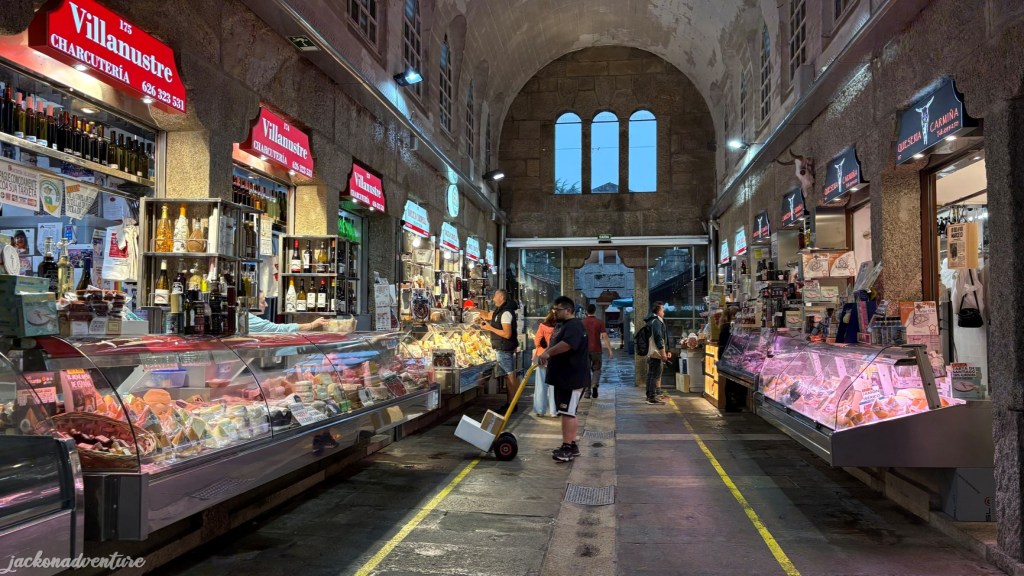
If you’re looking for fresh local food or want to taste some local cuisine, head to the Mercado de Abastos Food Market.
Opened its doors in 1873, the traditional market is a great place to sample local delicacies. It served as the main source of fresh produce for travelers, pilgrims, local families and restaurants. Around 70 producers and traders sell a wide range of meats, regional cheese, fresh seafood from the Galician coast, locally grown vegetables, artisan breads, regional wines, Galician spirits and seasonal fruits.
If you’re in the city on a Saturday, come to the lively food market and join other travelers and locals to experience the best of Galician food and soak in the vibrant atmosphere. These stalls prepare beautifully cooked meals, including small plates, sandwiches, or tapas-style bites.
Location: Rúa das Ameas, s/n, 15704 Santiago de Compostela
Opening Hours: Monday to Saturday from 7 am to 4 pm
Take a free local guided walking tour
Join a knowledgeable local guide to explore this fascinating city. Whether you’re seeking the city’s historic depth or its modern charm, there’s no better way to experience Santiago de Compostela than on foot. The city is much more than the final destination of the Camino de Santiago
A guided walking tour offers an excellent opportunity to discover the rich history of the Galician capital, uncover captivating legends and learn the local traditions with stories told by an expert local guide. You can roam through the charming cobblestone streets, surrounded by breathtaking architecture, historic monuments, churches, and public squares.
Travel Tips: GuruWalk and Sandeman offer excellent free walking tours in the city. A small gratuity is always appreciated as a gesture of thanks for the guide’s effort and dedication in sharing insights about the city.
Have a taste of Torta de Santiago
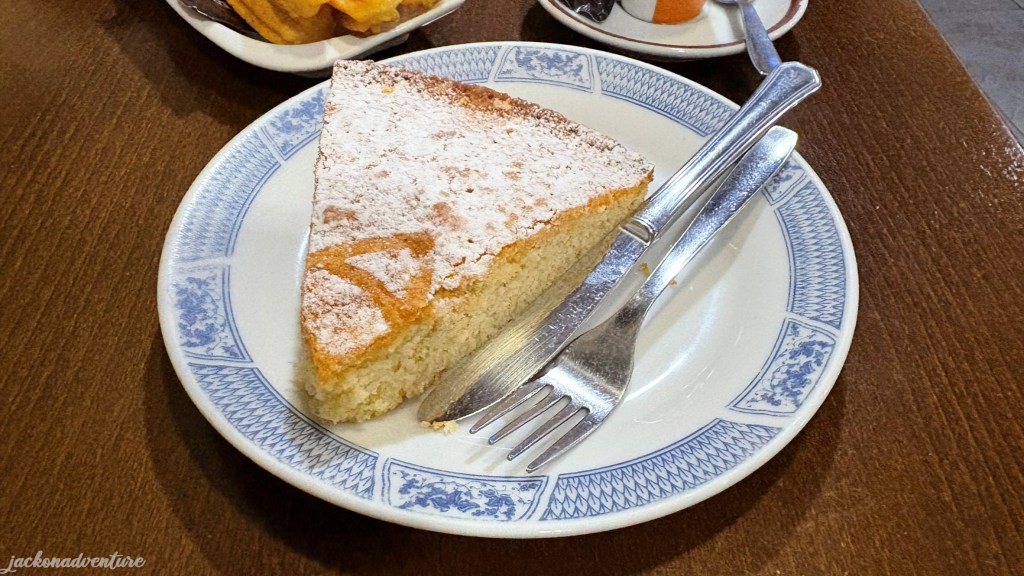
Torta de Santiago, literally meaning “cake of St. James,” is a traditional almond cake from Galicia whose origins are tied to the Middle Ages and the Camino de Santiago. It is made with ground almonds, eggs and sugar, and may include additional flavoring, such as lemon zest, sweet wine, brandy or grape marc.
The dessert has a lot of history behind it. It is known that this recipe was first documented in 1577 by the clergyman Pedro de Portocarrero, who named it “Torta Real.” Centuries later, the original recipe was found in a recipe notebook in 1868, and was called “Tarta de Santiago.” It was a recipe book by Luis Bartolomé de Leybar and it was later introduced into the Galician confectionery industry.
The tradition of decorating the cake with the Cross of Saint James dates to 1924, when the founder of Casa Mora wanted to give the dessert a distinctive touch. He created the symbol by dusting powdered sugar over a mold in the shape of the Cross of Saint James. The idea gained great popularity and other confectioners in Santiago soon followed suit.
Meander through Parque de la Alameda
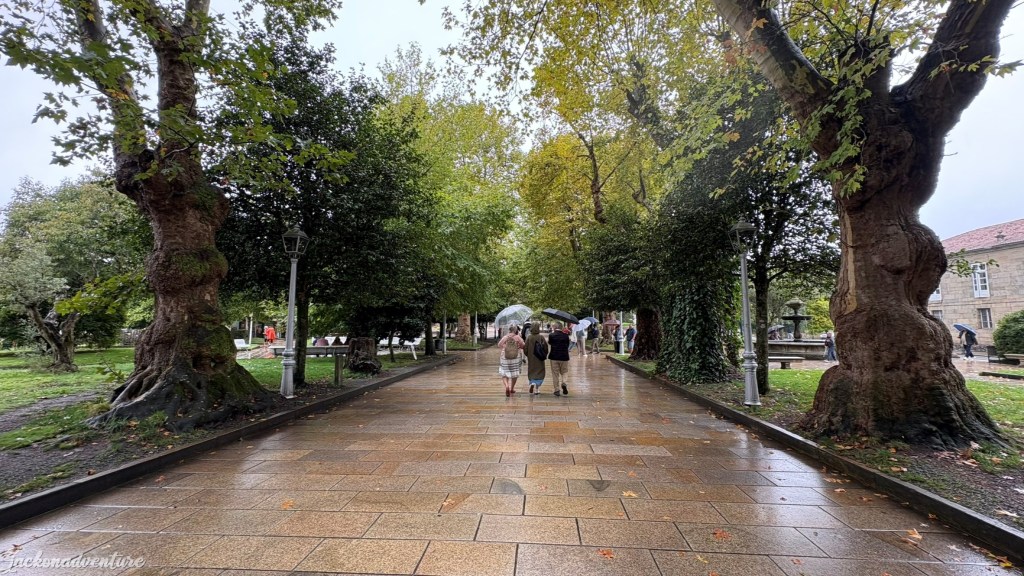
This gorgeous 16th-century Alameda Park (Parque de la Alameda) is a perfect spot to rest your feet after a long city exploration. The park is surrounded by oaks, chestnut trees, eucalyptus trees, cypresses, and palms.
Benches are plentiful with shady trees around the park where you can relax, either at Paseo de Alameda, Carballeira de Santa Susana or Paseo da Ferradura. The park contains numerous small chapels, fountains, sculptures and monuments.
Walk to Miradouro de Catedral to enjoy a picturesque postcard view of the magnificent Cathedral and Old Town.
Location: Rúa do Campiño da Ferradura, 15705 Santiago de Compostela
Entrance Fee: Free
Meet the Fandiño sisters
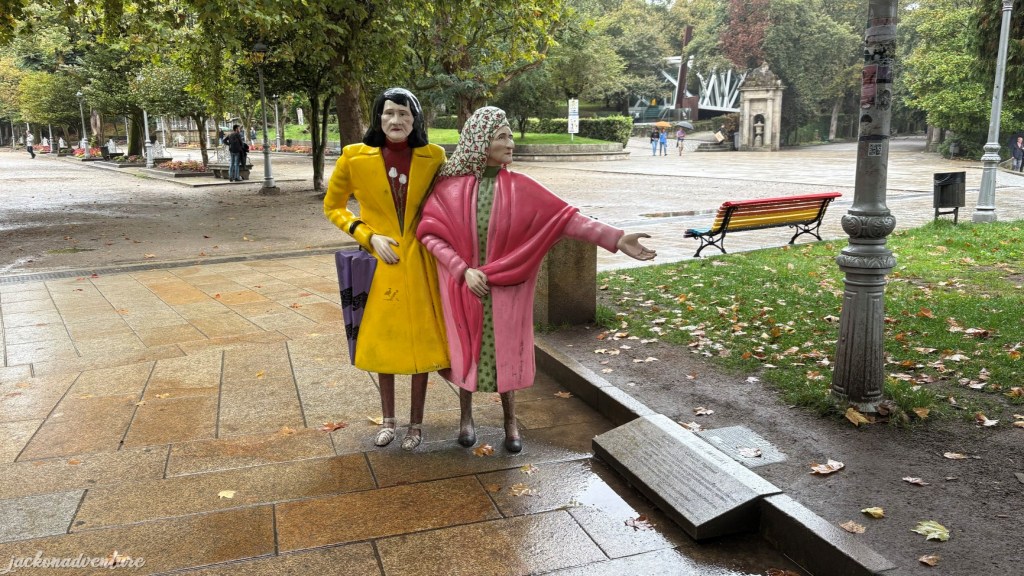
One of the most iconic statues in Parque de la Alameda is the colorful As Duas Marias, clothed in bright attire, with a cheeky wink and a friendly hand reaching out to meet passers-by. The sculpture is dedicated to two sisters, Coralia and Maruxa Fandiño, who were very popular locals in the 60s and 70s.
There is, however, a tragic story behind them. They were part of a liberal-thinking family and some of their brothers were involved in the anarchist movement in the 1930s, before the Spanish Civil War broke out. Their brothers were believed to have escaped and gone into hiding during the war and the dictatorship of General Franco. The rest of the family remained in Santiago and were often harassed and questioned by authorities.
After the Civil War, the sisters lived in poverty and struggled to find jobs due to political pressure. Their neighbors made sure they were well cared for, buying them food and raising money to find a new apartment for them when their home was destroyed by a storm.
The sisters were known by the nickname ‘As dúas en punto’ (2 o’clock), when there was a time they chose to go for their daily walk around the Old Town and Alameda Park. Their flamboyant fashion sense and bright clothing certainly made them stand out from the crowd. They passed away in the 1980s, but they are always remembered and honored through this iconic sculpture built in 1994. It is regarded by many as a reminder of a dark past, when the duo added their touch of colorful and delirious folly.
Location: Parque de la Alameda, P.º Central da Alameda, s/n, 15705 Santiago de Compostela
Discover the University of Santiago de Compostela
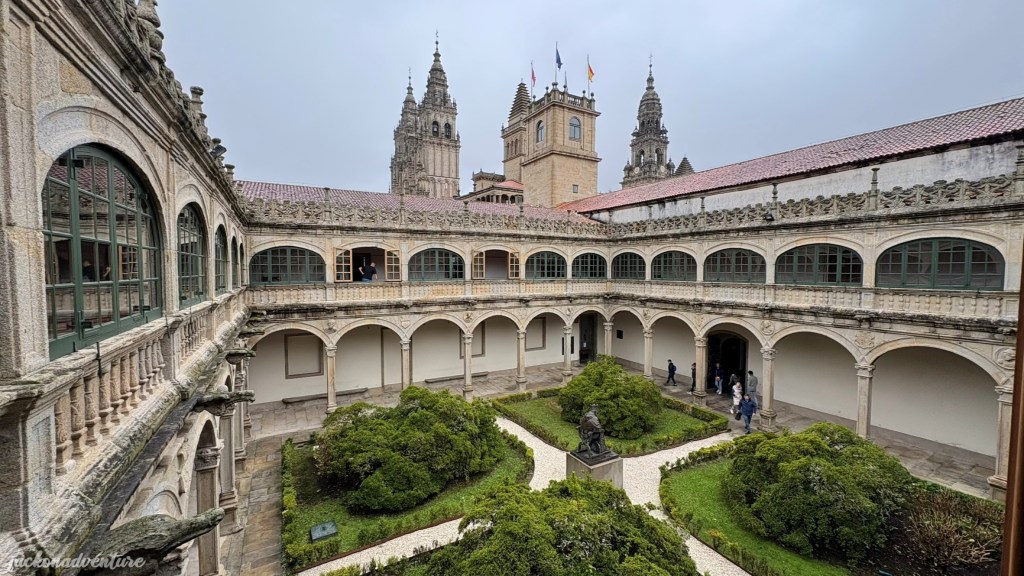
The University of Santiago de Compostela dates back to 1495 when Lope Gómez de Marzoa founded the school with the help of San Martino Pinario. It was originally a school for religious teaching.
The school separated itself from religious instruction with the help of Juan Álvarez de Toledo in 1555. It later focused on other fields such as science, arts and humanities, which are highly emphasized in its culture and history.
The university currently holds over 1 million invaluable texts. Temporary exhibits on the second floor showcase discoveries of ancient sites within the city wall.
The statue of Alonso III de Fonseca stands in the center of the garden square in remembrance of his tenure as Archbishop of the city in 1507. He consolidated the University and provided many artisans with sponsorships.
Location: Praza do Obradoiro, 0, 15705 Santiago de Compostela
Entrance Fee: Free
Visit the old College of San Jerónimo
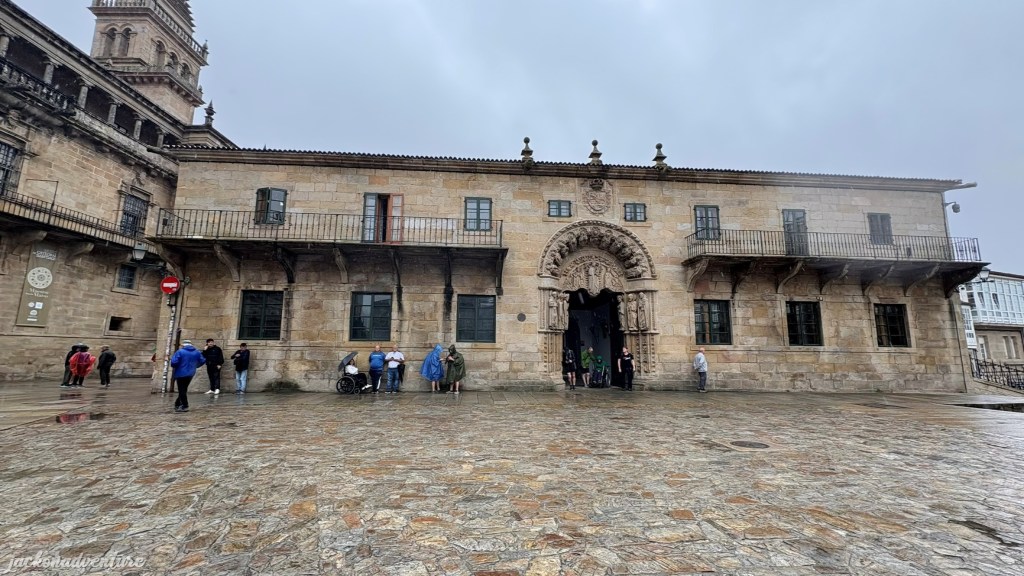
Also founded by Alonso III, the College of San Jerónimo was established in 1501 as a colexio menor to provide study of grammar for poor students and artists. It occupied the Old Hospital for a little over a century. Unfortunately, it was relocated to allow the expansion of the Convent of San Martiño, which was administered by the Benedictine friars.
A Romanesque entrance of the old school was incorporated into the main façade. The tympanum is dominated by the figures of the Blessed Virgin and Child. There are six sculptures of Apostles and the founding saints of the mendicant orders: Saint James the Greater, Saint John, Saint Francis of Assisi, Saint Peter, Saint Paul and Saint Domingo de Guzmán. The two coats of arms of Alonso II de Fonseca are preserved on two of its façades above the entrance.
The building was converted into a Teaching School in the 20th century. It has housed the Rectorate of the University of Santiago de Compostela since the 1980s.
Location: Praza do Obradoiro s/n, Santiago de Compostela
Entrance Fee: Free
Explore the grand Hostal dos Reis Catolicos
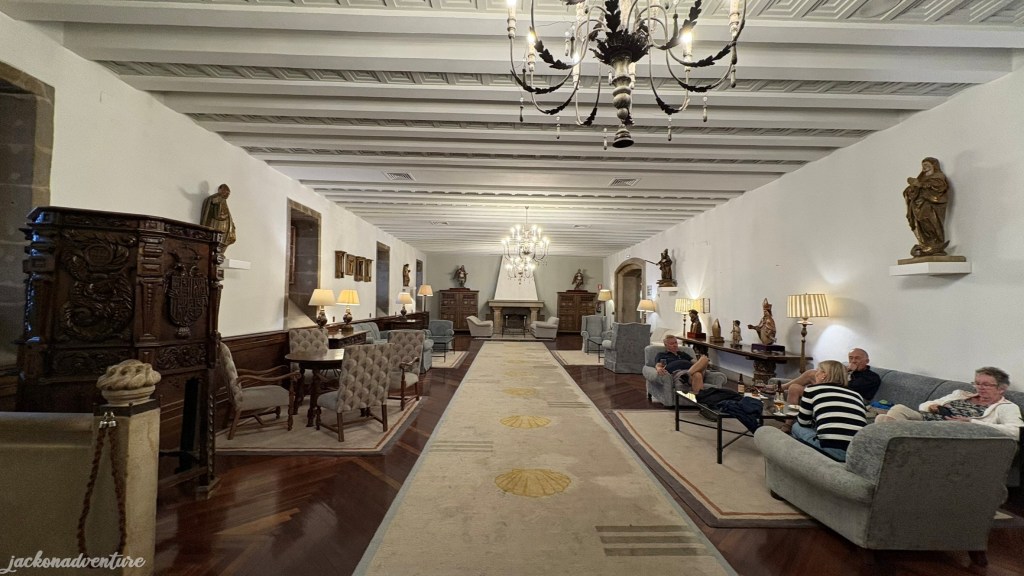
The Hostal dos Reis Católicos is one of only two five-star Parador hotels in Spain and one of the oldest hotels in the world. It’s a living piece of history that captures the spirit of the Camino de Santiago.
In 1486, after their pilgrimage to Santiago de Compostela, Queen Isabella I of Castile and King Ferdinand II of Aragon commissioned the construction of the “Royal Hospital” for pilgrims. It took 13 years to complete and the structure remained in its original form until the 18th century. The lovely Plateresque façade features the figures of Adam, St Catherine and St John the Baptist on the top. Additional figures include Eve, St Lucy and Mary Magdalene. The 12 apostles are depicted along the doorway into the hotel. Two medallions bear the likenesses of the Catholic Monarchs.
Traditionally, pilgrims could present their Compostela as proof of their pilgrimage and rest for three days free of charge, receiving food, medical care, and spiritual support. Although the practice has faded away over time, a free meal is still offered only to the first 10 pilgrims arriving each day with their earned Compostela in hand.
Today, the hotel offers a variety of accommodations, ranging from standard rooms to luxurious suites. It is furnished with antique pieces and charming tapestries that reflect the building’s rich heritage. Every detail reflects an atmosphere of elegance and comfort, ensuring the stay is an unforgettable experience.
Even if you’re not staying here, you can walk through its passageways to take a glance at its architectural splendor and historical legacy. Located in the basement of the hotel are the elegant Restaurante Dos Reis and Enxebre, both serving local Galician cuisine but offer distinct dining experiences.
Location: Praza do Obradoiro, 1, 15705 Santiago de Compostela
See the Convento de San Francisco de Santiago

Dating back to the 17th century, the Saint Francis Church (Convento de San Francisco de Santiago) is a former convent that housed Franciscan monks in the 18th century. The legend of its foundation is preserved in an inscription on the wall, attributed to St. Francis of Assisi during his pilgrimage to the Galician capital in 1214.
The story goes that Saint Francis was welcomed into a house on Mount Pedroso by the family of a poor charcoal burner named Cotoloy. He founded the convent to fulfill Saint Francis’s request. To Cotolay’s surprise, the friar asked him to search near a spring located in San Paio do Monte, where he found a treasure that allowed him to finance the construction. The leaders of the Monastery of San Martiño Pinario agreed to provide an annual basket of trout in exchange for the land on which the church would be built.
The present church was constructed of granite between 1742 and 1749. The façade was later renovated in Neoclassical style, which included an image of San Francis created by the sculptor Ferreiro. His monument stands in the atrium of the complex.
After the monks moved to a modern facility, the convent was converted into a four-star hotel and restaurant that serves a pilgrim menu with traditional convent dishes. The monks continue to carry out evangelical, pastoral, social, educational and cultural activities in the convent.
Location: R. de San Francisco, 15704 Santiago de Compostela
Opening Hours: Daily from 11 am to 1 pm and 5 pm to 8 pm
Entrance Fee: Free (€3 to the museum)
Visit the Monastery of San Martiño Pinario

The Monastery of San Martiño Pinario is a 16th-century Benedictine monastery dedicated to the Virgin Mary, the destroyer of sins, the assumption, and coronation. It was originally a chapel founded by Benedictine monks in the 9th century after they heard about the remains of Saint James.
After reconstruction, it became the second-largest monastery in Spain, following the San Lorenzo de El Escorial near Madrid. It is a stunning example of a Baroque masterpiece, with an impressive wood-carved altarpiece designed by Fernando de Casas Novoa.
The monastery currently serves as a seminary for Santiago and the headquarters of the Diocesan Historical Archive. It also houses the Museum of Religious Art, comprising 12 rooms filled with paintings, sculptures, goldsmiths, engravings, archeological remains, biblical collections, old printing presses and a historic pharmacy. They also provide hospitality to guests in its Hospederia Hotel.
Location: Pl. de San Martiño, S/N, 15704 Santiago de Compostela
Opening Hours: Monday to Saturday: 10 am to 2 pm and 4 pm to 6 pm
Entrance Fee: €3
Visit Igrexa de Santa María do Camiño
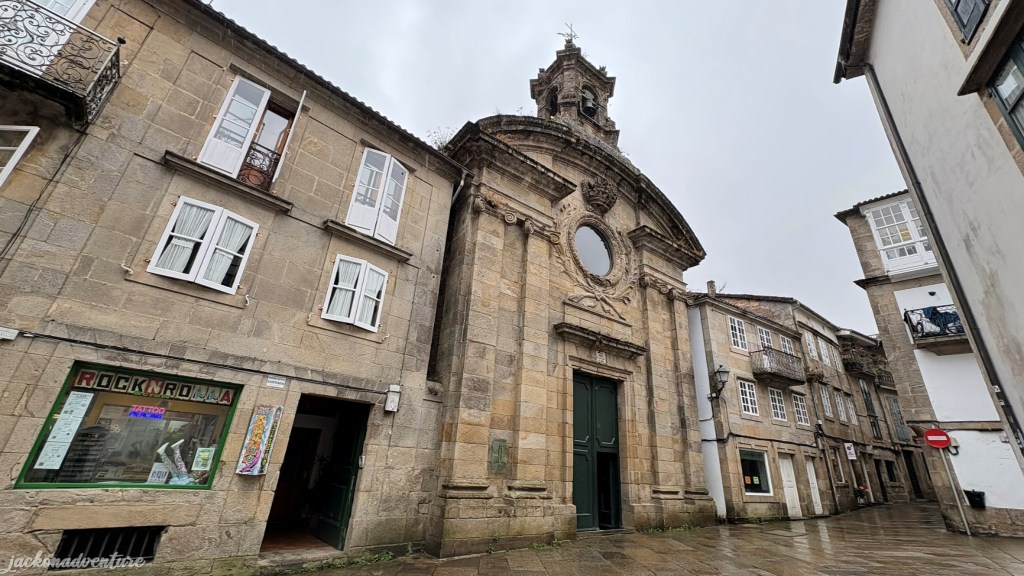
The Church of Santa María do Camiño dates back to the 18th century wth a predominant Neoclassical style. The church marks the entrance to Santiago de Compostela along the French Way, where pilgrims walk through the Porta do Camino (Gate of the Way of St. Jamesr).
Location: A, R. Travesa, 15704 Santiago de Compostela
Opening Hours: Daily from 8.30 am to 5.30 pm
Entrance Fee: Free
Visit the Museum of the Galician People
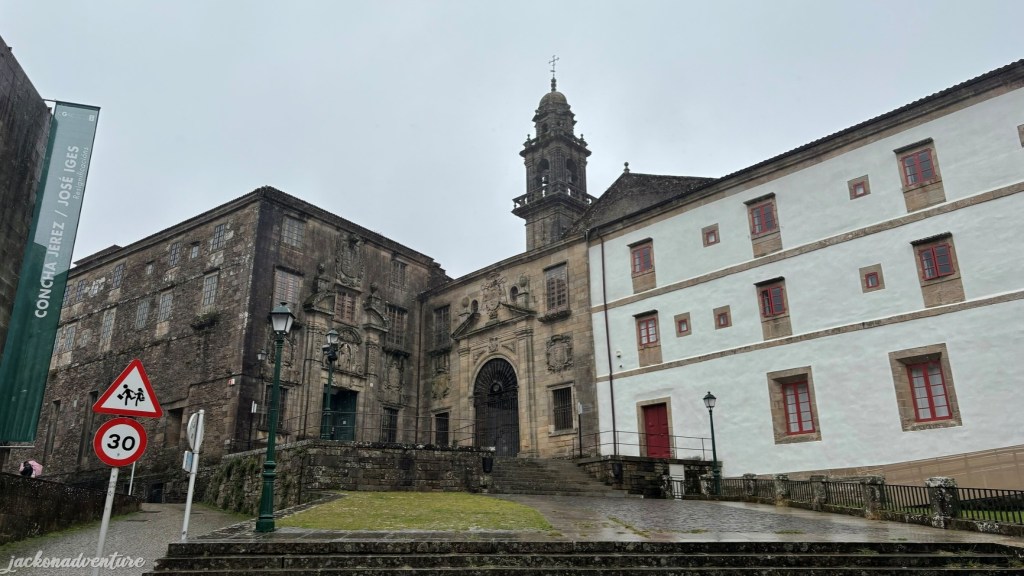
One of the most fascinating places in Santiago is the Museum of the Galician People (Museo do Pobo Galego). where you can learn more about Galicia’s rich history and culture.
This ethnographic museum presents various aspects of the Galician coast and rural life, including traditional trades, customs, beliefs and lifestyles. It is also home to a collection of artifacts, paintings, furniture, tools and sculptures.
Location: Costa de San Domingos, 3, 15703 Santiago de Compostela
Opening Hours: Tuesday to Saturday: 11 am to 6 pm/ Sunday: 11 am to 2 pm
Entrance Fee: Adults: €5/ Adults aged 65+ and Visitors with Disabilities: €2/ Children below 18: €2
Visit the Convent of San Domingo de Bonaval
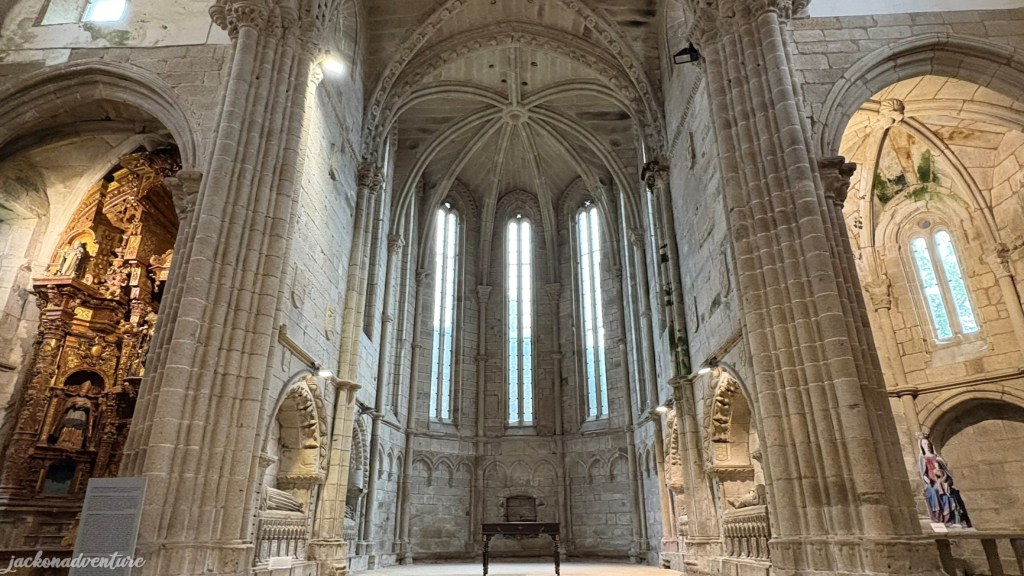
Behind the museum, beyond the cloister, stands the Convent of San Domingo de Bonaval, founded by St. Dominic de Guzmán in 1219. It was rebuilt in Baroque style in 1695.
The church houses the Pantheon of Illustrious Galicians in one of the side chapels. Some noble families of Moscoso and Castro were buried here. The cloister contains an intricately carved Gothic stone cross. The spacious hall often serves as a venue for concert events and exhibitions.
One of the main highlights is the marvellous triple spiral stairway designed by Domingo de Andrade. There are three independent ramps, each leading to different rooms, though only one reaches the viewpoint.


Location: Costa de San Domingos, 15703 Santiago de Compostela.
Opening Hours: November to March: Daily from 10 am to 8 pm/ April to October: Daily from 9 am to 8 pm
Entrance Fee: Free
Going Elsewhere in Spain?
If you are looking for more adventure in Spain, you can look at my other posts for some travel guides:
Like It? Pin This Article.


 Jack on Adventure
Leave a comment