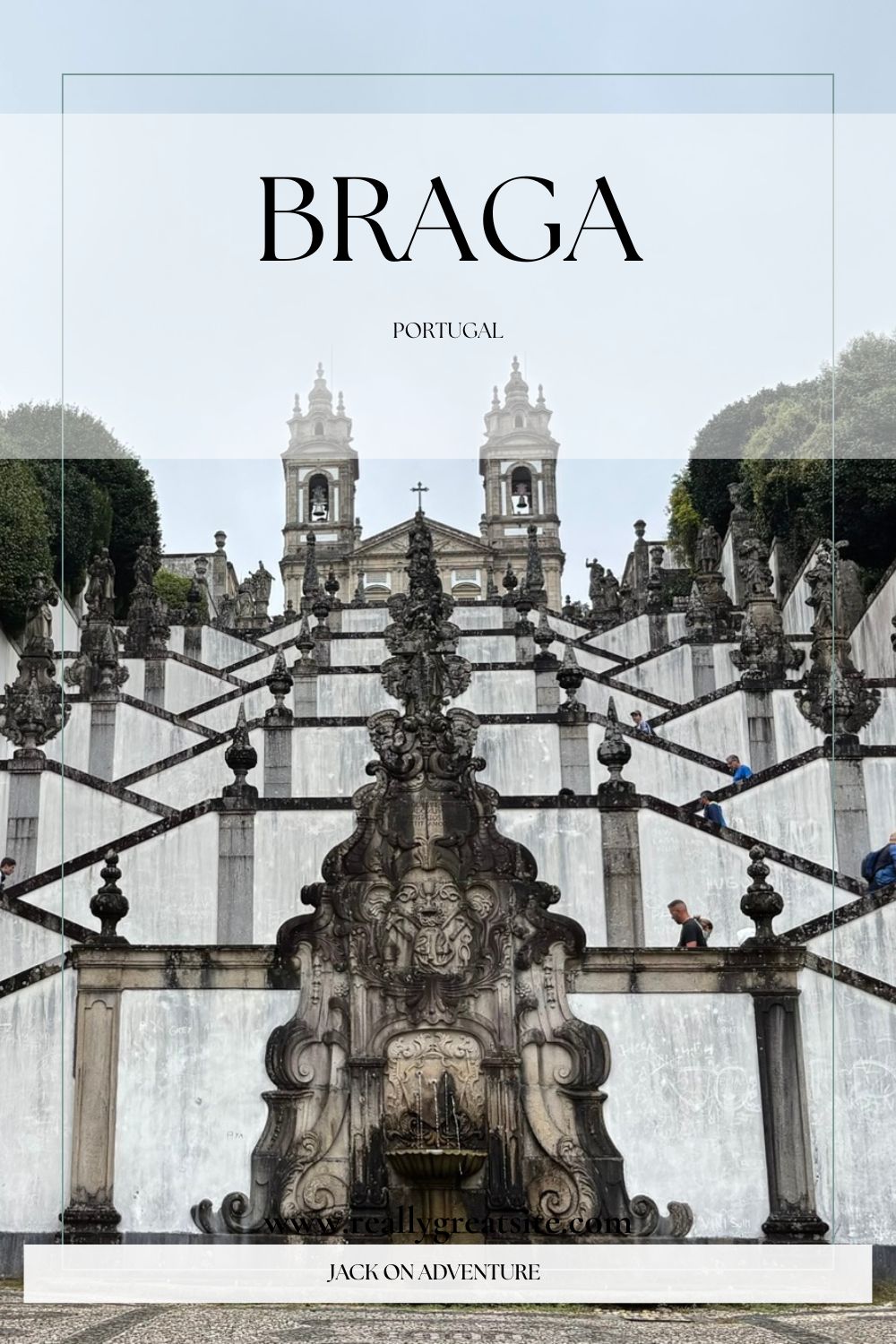
Located in the Minho region of northern Portugal, Braga is the third-largest city in the country after Lisbon and Porto. It is considered one of the oldest cities in Portugal and one of the world’s oldest Christian cities, boasting over 2,000 years of history.
Formerly known as Bracara Augusta, Braga was established as a Roman settlement in the 1st century BC. It was invaded by the Germanic tribes from the north, who took control of the city. Eventually, the Portuguese reclaimed the city, which became the major religious center during the Reconquista. As a result, numerous religious buildings can be found throughout the region.
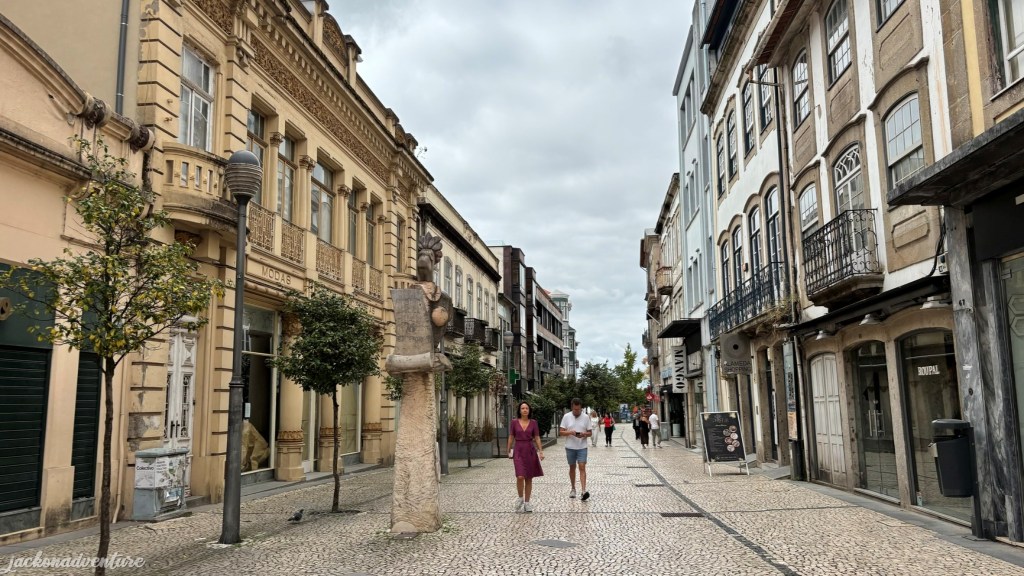
Nicknamed “Roma Portuguesa” (Portuguese Rome), this charming city is home to beautiful plazas, Gothic monasteries and churches. Among them are the mind-blowing Bom Jesus do Monte and Sé de Braga, the oldest cathedral in Portugal and the seat of the Archdiocese. The city is also known for its lively atmosphere, characterized by local markets, cozy cafés and unique festivals held throughout the year.
Best Time to Visit
The best time to visit Braga is between May and October. It is often possible to experience cooler weather during spring (March to May) and autumn (September to November), making it more comfortable to explore the city. If you’re here in late May or early June, don’t miss out on the Braga Romana Festival.
During summer, between June and mid-September, the weather is usually warm and dry, with temperatures ranging from 18 to 28 °C. The city tends to be crowded during this period, as festivals and outdoor dining attract many visitors.
The least popular time to visit is winter, when the city experiences the most rain. If you don’t mind the cold, then November to January are the good months to travel.
Getting There
By Bus
The closest airport to Braga is Porto’s Francisco Sá Carneiro Airport (Airport Code: OPO). It is not necessary to travel to central Porto to catch a bus to Braga. Direct bus services are operated by Getbus and Flixbus. A single ticket from the airport to Braga costs as little as €3 and the journey takes approximately 50 minutes. The bus departs from “Stop D”, located outside the terminal building and tickets can be bought directly from the bus driver.
If you’re staying in the city center, take the subway to Campanhã Bus Terminal and catch a bus operated by Getbus, Flixbus, ALSA, Rede Express or Renex. Buses depart more frequently from the city center and a single ticket costs as low as €2.50 per trip. The journey takes approximately 45 minutes.
By Train
Trains to Braga depart from Campanhã Train Station and São Bento Train Station, which are conveniently located in the heart of the city center. The train service is operated by the national railway system, Comboios de Portugal (CP).
The Alfa Pendular train takes between 54 and 71 minutes to reach Braga, with approximately 10 trains operating each day. The first train departs from São Bento at 6:15 am, and the last train leaves Braga at 11:32 pm. A single ticket costs at least €18 and can be bought online, at the ticketing office or ticket machine at the station. This schedule allows you to spend an entire day exploring Braga.
Getting Around
Braga is a compact city, best explored on foot through its windy alleys and cobbled streets. You can easily navigate around the city with many heritage buildings, churches and monasteries located close to one another.
There is an exception for Bom Jesus do Monte and Sameiro Sanctuary. You have to either take a local bus or an e-hailing car (Uber or Bolt) to reach those two uphill attractions.
The Best Activities for a Day Trip to Braga
Braga is one of the most popular day trips from Porto, located 42 kilometers away. If you are seeking a cultural experience, this city should be on your travel radar.
Although Braga is the third-largest city in Portugal, spending a day here can bring you to plenty of unique sights, including the jaw-dropping Bom Jesus do Monte Sanctuary. Narrow medieval cobblestone alleys connect to numerous Gothic churches, plazas and gardens in the city center.
Be amazed by the impressive Sanctuary of Bom Jesus
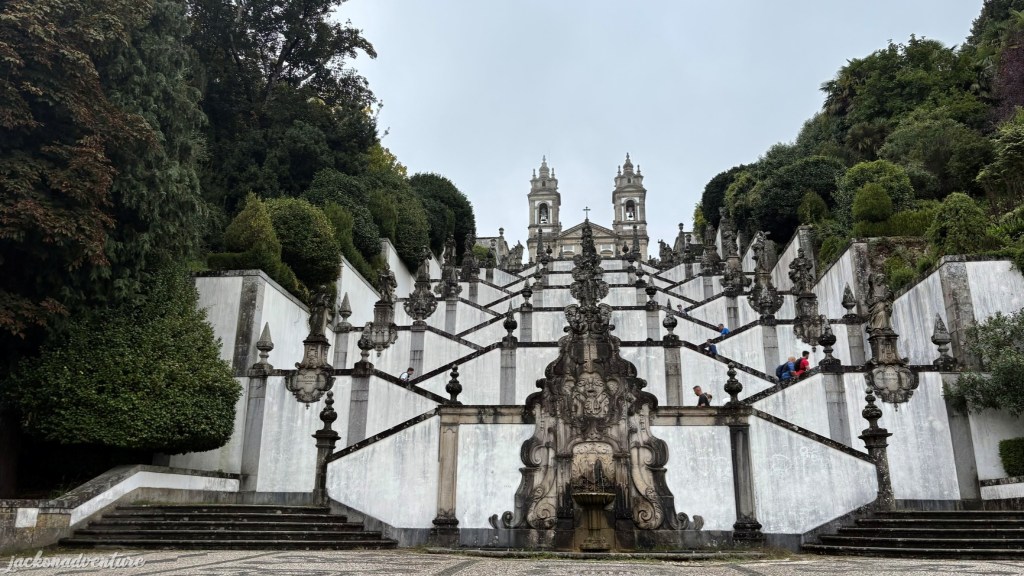
Nestled on the slopes of Mount Espinho, the Sanctuary of Bom Jesus do Monte is the most visited landmark in Braga. And this comes as no surprise because the monument is simply magnificent. It is renowned for its monumental stairways and Baroque architecture.
The 116-meter Baroque staircase, known as the Sacred Way welcomes many pilgrims who show their faith, devotion and gratitude to God by climbing 583 steps to the top on their knees. The stairway leading to the top features 17 landings, each adorned with fascinating fountains, allegorical statues, and other Baroque-style decorations. Such themes include the Fountain of the Wounds of Christ, the Fountain of the Five Senses and the Fountain of Virtues, which represents faith, charity and hope.
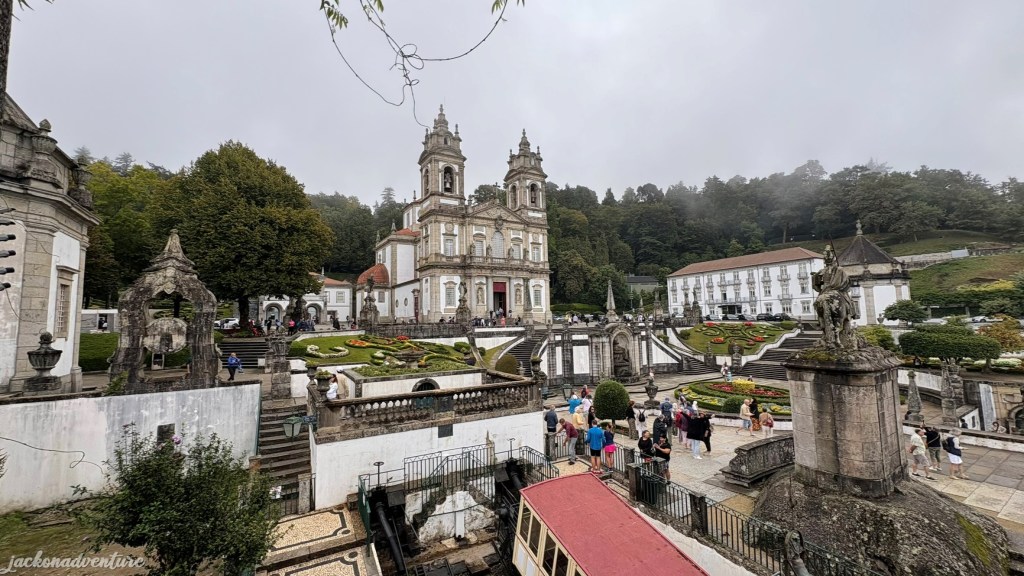
Built between 1784 and 1811 by Carlos Amarante, the Basilica is dedicated to the Bom Jesus (Good Jesus of Mount) and contains six chapels dedicated to the Passion of Christ. The Neoclassical pilgrimage church consists of exposed grey stonework, whitewashed plaster façades and esteemed bell towers. It houses several paintings by Pedro Alexandrino from the 18th century. The back altar, framed by two pillars and glowing warmly, depicts the Crucifixion.
The Museum of Confraria next door has a collection of religious pieces, as well as the Library, which was founded in 1918. You can wander along the park that contains several caves, gazebos, fountains, figurines, and chapels. There is also a small lake and a neighbouring teahouse.
Travel Tips: If you prefer to use the funicular, a one-way ticket costs €1.50, and the ride usually takes around 20 minutes.
Location: Estrada do Bom Jesus, 4715-056 Tenões
Getting There: Take Bus No. 2 (also mention “Bom Jesus” below the number) from the bus stop opposite Igreja do Salvador to the sanctuary. Bom Jesus bus stop is the last stop for this bus route. The 30-minute bus ride costs €1.60 and tickets can be purchased from the driver.
Opening Hours: April to October: Daily from 9 am to 8 pm/ November to March: Daily from 9 am to 7 pm
Entrance Fee: Free
Explore the stunning Sanctuary of Our Lady of Sameiro
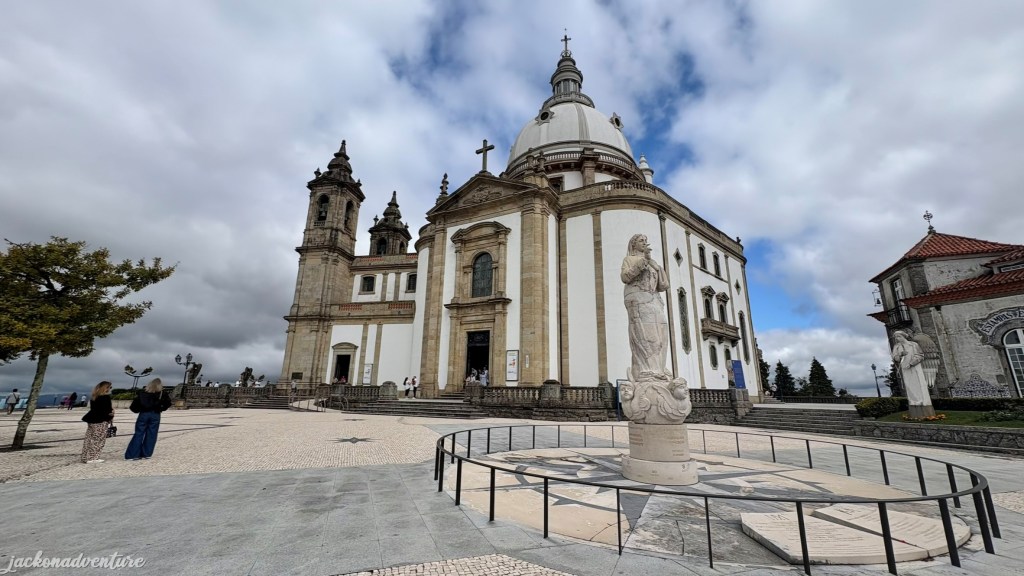
Perched on top of Monte Sameiro, the Sanctuary of Our Lady of Sameiro is one of the most important centers of Marian devotion and the largest shrine in the country.
Known as Santuário de Nossa Senhora do Sameiro, the church dates back to June 14th, 1863, when Father Martinho António Pereira da Silva decided to place a statue of Our Lady on the top of the hill. However, the influx of pilgrims led to the creation of a chapel in 1873, which was later elevated to a basilica in 1890.
The sanctuary is dedicated to Our Lady of Sameiro, whose image is located at the main altar. The sculpture was carved in Rome and blessed by Pope Pius IX. It is adorned with a magnificent crown made of 2.5 kilograms of solid gold, as well as precious jewels from Queen Amélia de Orleães.
The main altar was consecrated on June 12th, 1941, a few months after it was decorated with two marble columns from Estremoz (a town in the Évora district). Interestingly, but each of the columns weighs more than 6 tons!
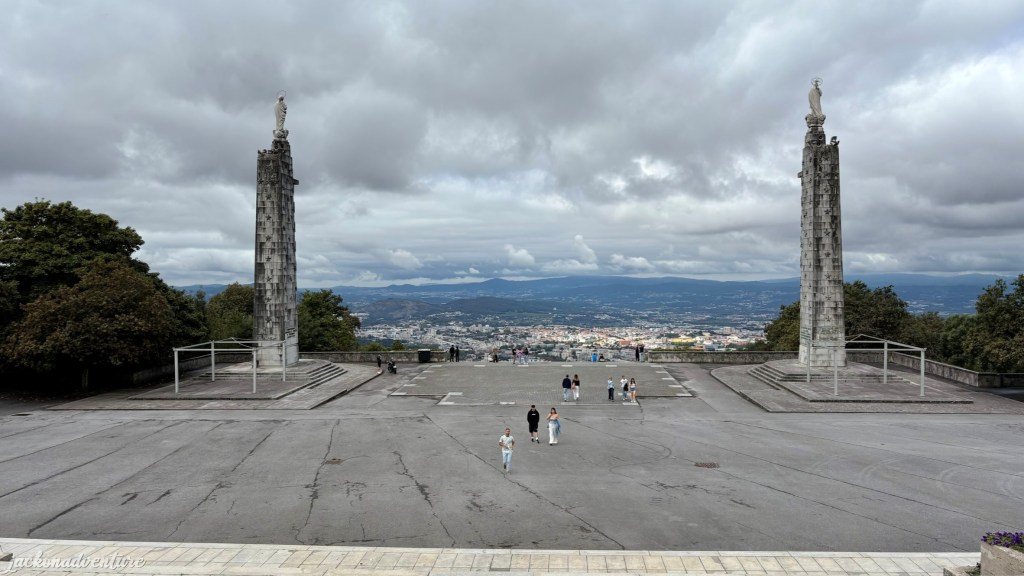
In front of the church stands an imposing staircase, faturing two tall pillars topped with statues of the Virgin Mary and the Sacred Heart of Jesus. You can admire the breathtaking panoramic views of Braga Old Town from the stairway.
Every year, the sanctuary attracts many devotees, especially during the pilgrimages held on the first Sunday of June and the last third of August. The liturgical feast of Our Lady of Sameiro is celebrated on June 12.
Location: Av. Nossa Sra. do Sameiro 44, 4715-616 Braga
Getting There: Take Bus No. 88 from Rua do Raio (Senhora-a-Branca) in Braga Old Town or Est Bom Jesus bus stop to Santuário (Stop ID: 16079)
Opening Hours: April to June and October: Monday to Saturday from 10 am to 12 pm and 1 pm to 7 pm; and Sunday from 7 am to 7 pm/ July to September: Monday to Saturday from 8 am to 1 pm and from 2 pm to 7 pm; and Sunday from 8 am to 8 pm/ November to March: Daily from 9 am to 1 pm and 2 pm to 6 pm
Entrance Fee: Free
Mermerze the magnificent Braga Cathedral
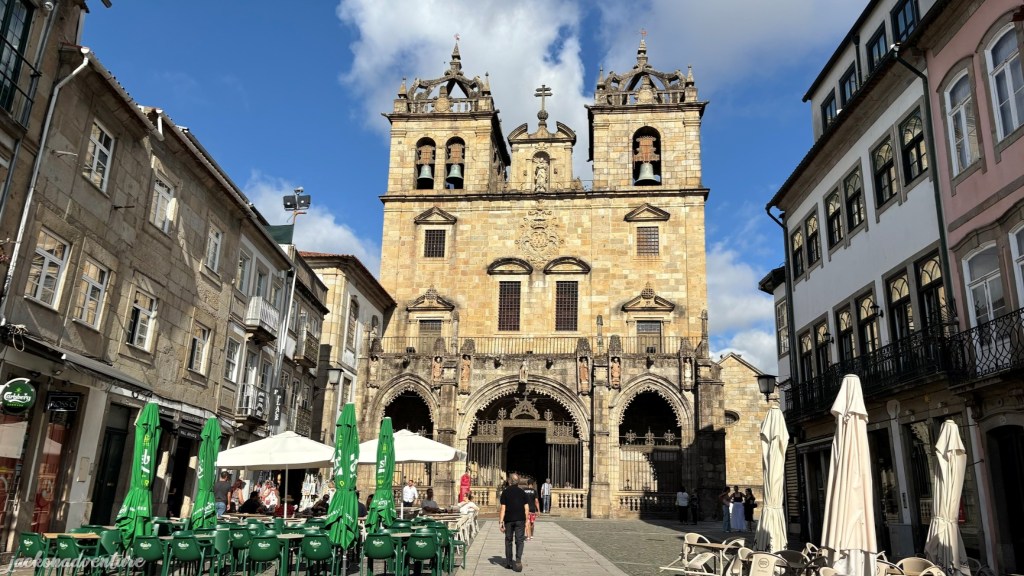
The Braga Cathedral (Sé Cathedral de Braga) was the first Portuguese cathedral, erected several decades before the founding of the country. Also known as the Cathedral of Santa Maria de Braga, it preserves artistic heritage from more than nine centuries of history. It was built at the end of the 11th century and was dedicated to the Virgin Mary by Bishop Pedro in a solemn session on August 28, 1089.
The cathedral is the seat of the Archdiocese of Braga, a position somewhat equivalent to the archbishop of Canterbury in England. The Diocese of Braga was created in the 3rd century BC and became the “headquarters” of the Christianization of Galicia.
Over the centuries, modifications have been made to the Braga Cathedral. It is one of the most impressive examples of old-world religious architecture that blends with Gothic, Baroque, Romanesque and Moorish styles.
The Porta do Sol door, the main portico and the apse of the cloister of Santo Amaro all preserve the original Romanesque style. The entrance porch to the church was built in the 15th century in the Gothic style. At the right entrance of the cathedral is the Manueline style white limestone font of Ançã, where the tomb of Infante D. Afonso (the first son of King João I and of D. Filipa de Lencastre) is located.

With extra free time, take a guided tour to the Chapel of Kings, where Henry of Burgundy and Teresa de León, parents of the first king of Portugal, D. Afonso Henriques, are buried. The mummified body of Archbishop Dom Lourenço Vicete is also kept here. His missing eye, which he lost during battle, is visible at his tomb during the Battle of Aljubarrota in 1385. You can also closely observe the gilt wood carving of the choir stalls and the double organ made in the early 18th century inside the cathedral.
Location: R. Dom Paio Mendes, 4700-424 Braga
Opening Hours: Cathedral: Monday to Saturday from 9.30 am to 1 pm and 2.30 pm to 6 pm, and Sunday from 10.45 am to 11.15 am and 12.30 pm to 1 pm/ Treasury Museum: Tuesday to Sunday only
Entrance Fee: € 2 (Guided tour through the chorus: €5/ Treasury Museum: €3)(Free for visitors with disability)
Stroll through Praça da República
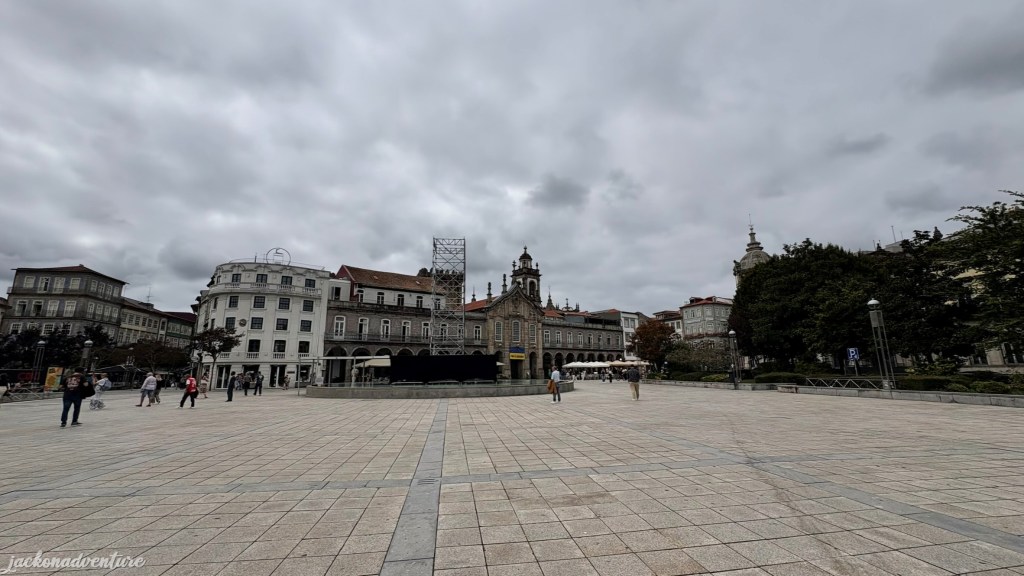
The vibrant atmosphere of Chafariz da Praça da República is adorned with lush greenery and lively cafés. It serves as the main meeting point for locals and visitors and is often filled with hips of life and activities. The three main highlights here are the large fountains, the Lapa arcades and the Lapa church.
The square stands as a proud testament to Braga’s architectural beauty. The magnificent fountain, dating to the 19th century, features intricate designs that reflect the artistic flair of its time. The Lapa arcades consist of 19 arches and were built on the foundations of the old castle walls.
Location: Praça da República, 4700-328 Braga
Visit the Basílica dos Congregados
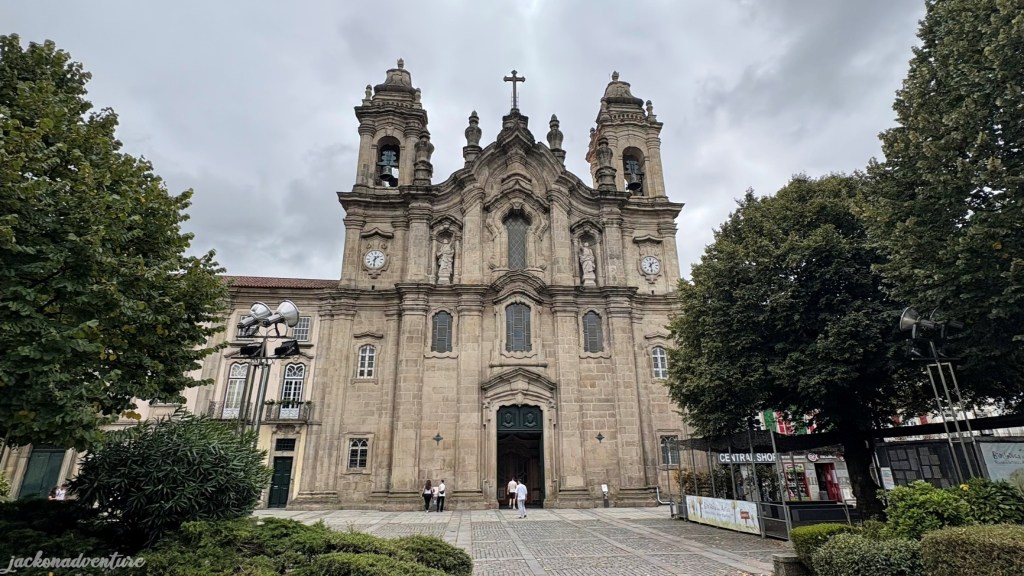
The convent and basilica were commissioned by the Congregados of the Oratory of St. Philip Nery upon his arrival to Braga in 1687. The construction of the Baroque church began in 1703 and dragged on for many decades.
The façade of the church, as well as the altarpiece of Our Lady of Sorrows, the organ case and the private chapel of Our Lady of Aparecida, follow the lines of the architect André Soares, who also designed the eastern wing of the convent building.
After the extinction of the religious order in 1834, the convent was used as a high school, a library and later as a pole of the Universidade do Minho.
The two notable statues created by sculptor Manuel Nogueira da Silva represent Saints Filipe de Nery and Martinho de Dume and were the final part of the church to be completed in 1964.
Location: Av. Central 98, 4710-229 Braga
Opening Hours: Daily from 8 am to 6 pm
Entrance Fee: Free
Take a glance at the Church of the Third Order of St. Francis

The Church of the Third Order of St. Francis (Igreja dos Terceiros de São Francisco) was established in 1672 under the inspiration of the Congregation of Franciscans. It was built between 1685 and 1730 with the help of the charity donations of the worshippers.
The façade was designed by Manuel Fernandes da Silva in a blissful combination of Mannerism and Baroque styles. The image of Our Lady of the Conception can be observed from the outside. The decoration had the intervention of artists such as André Soares, Carlos Amarante and José de Magalhães Calheiros.
Unfortunately, the church is not open to the public and its architecture of exterior architecture can only be viewed.
Location: Largo de São Francisco 1930, 4700-317 Braga
Take a break at Jardim de Santa Bárbara
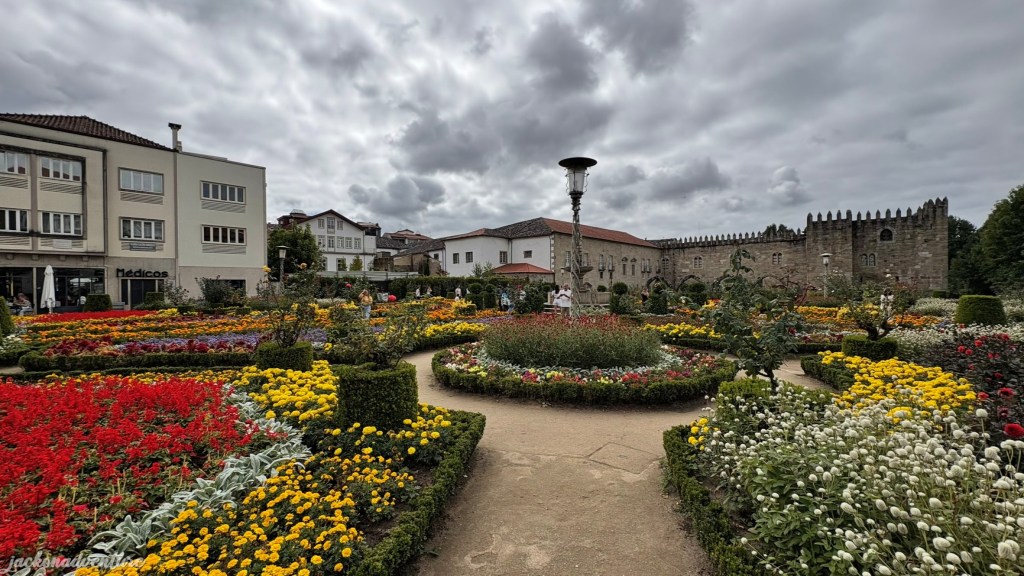
It’s time to deserve a much-needed break after a long day walk along the hilly slopes to the two sanctuaries and the historic center of Braga.
The mystical Jardim de Santa Bárbara is a small park planted with seasonal, colorful flowers. It is an oasis in the city where locals and visitors to mingle around and admire the surrounding medieval architecture.
The 17th-century fountain at the center of the garden was originally located in the old Convent of Our Lady of Remedies. The top of the fountain is a representation of Saint Barbara who was born in Turkey at ended in a tragic story. According to Catholic tradition, Saint Barbara was punished by her father, who disapproved of her professing the Christian faith. She was beheaded after her torture in an attempt to reconvert her.
The walls behind the garden is an old burned-down castle. The Gothic arches are the remains of the Episcopal Palace where Braga’s archbishop once resided.
Location: R. Dr. Justino Cruz 129, 4700-317 Braga
Opening Hours: 24 hours
Entrance Fee: Free
Admire the charming Igreja do Carmo
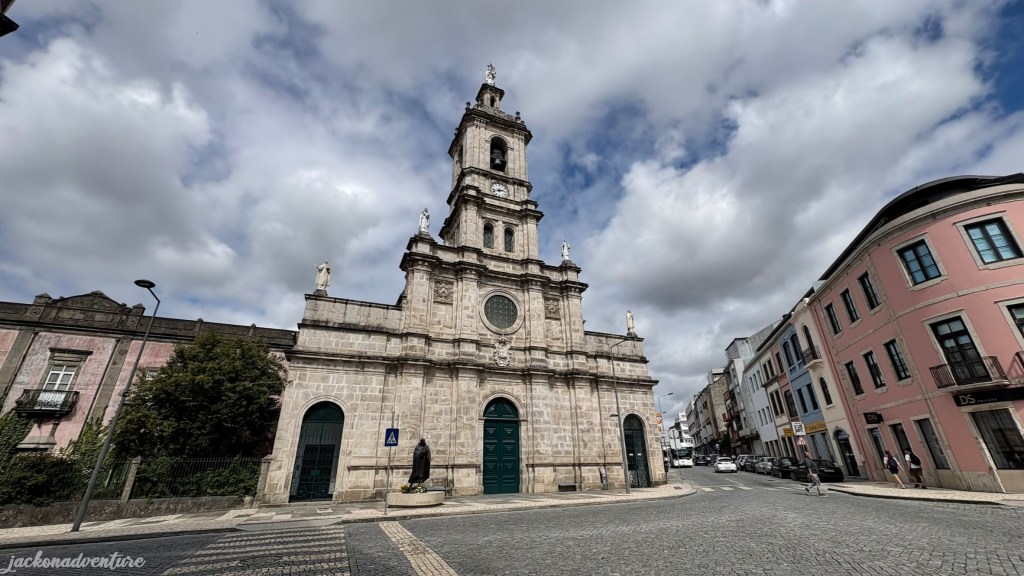
Igreja do Carmo was founded on February 1, 1653 by Friar João do Espírito Santo. The church features Mannerist, Baroque, Rococo, Neoclassical, and Revivalist architecture with the floor plan in the shape of a Latin cross.
Location: Tv. do Carmo s/n, 4700-370 Braga
View the Old Palace of the Archbishop

The Old Palace of the Archbishop is the initiative of the Archbishop Dom José de Bragana that dates back to the year 1746. The building was designed by André Soares, presenting decoration still integrated in the canons of the Johannine Baroque period but has traces of the Rococo style.
Following a massive fire in 1866, a significant part of the building was destroyed. Restoration work was done in 1930 to house the historical nucleus of the Braga Public Library and District Archive.
Location: Praça Mun., 4704-553 Braga
Pass through the Arco da Porta Nova
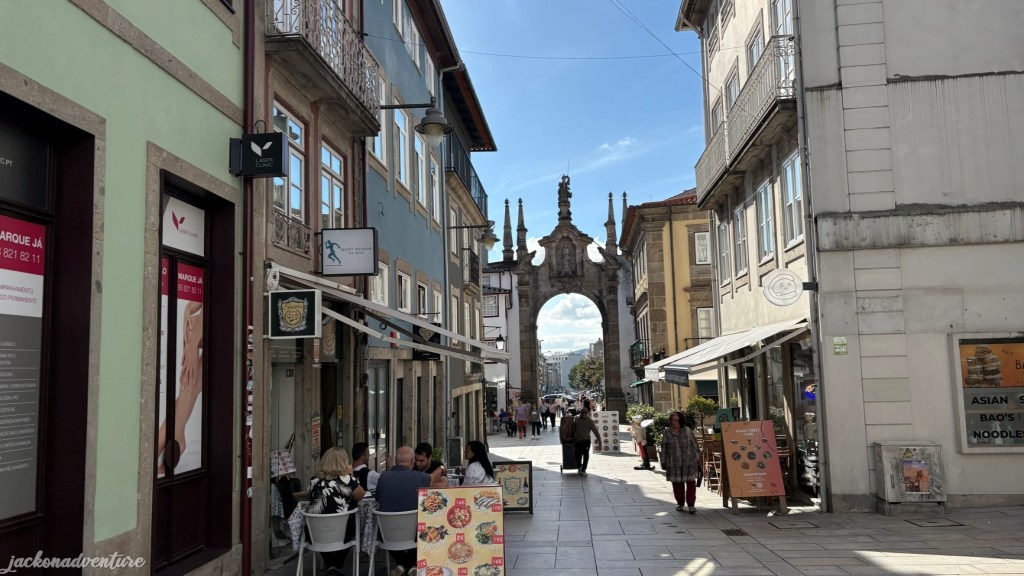
Located at the western entrance of Braga is Arco da Porta Nova. The arch is one of the oldest gates to the city, dating back to the 16th century. Back then, Braga was completely enclosed by a fortified wall and this arch was one of the gateways into the city.
This historical landmark was renovated in later eras and was decorated with Baroque and Neoclassical style. Behind the arch is Rua do D. Diogo de Sousa, a street great for shopping and finding souvenirs.
Location: R. Dom Diogo de Sousa 127, 4700-424 Braga
Spot the statue of Augustus Caesar
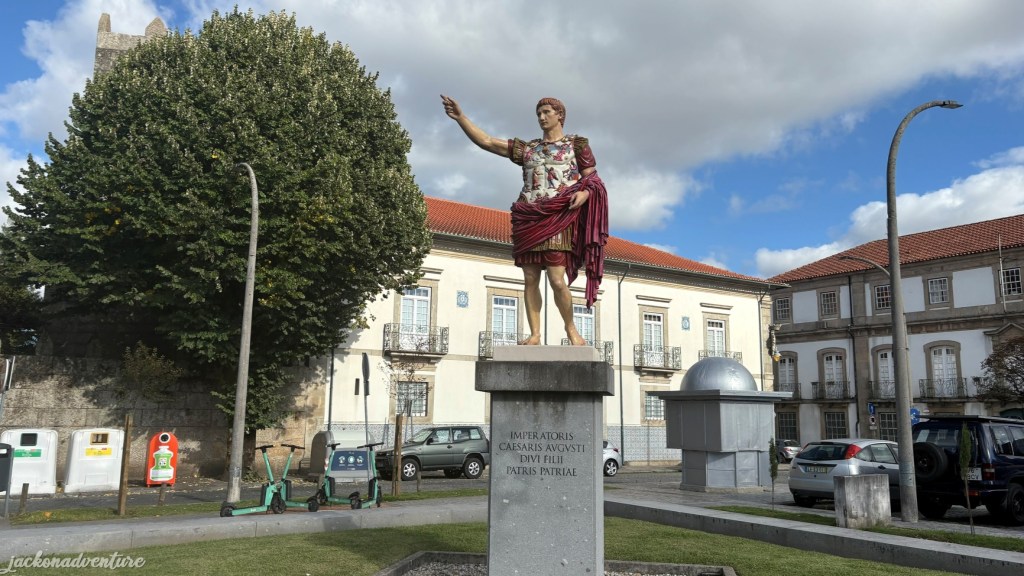
Hello, Augusta! One of the Roman leaders who has inspired my life since childhood.
The statue of Augusta commemorates the period in Roman history when Braga was once known as the Roman city of Bracara Augusta. Augustus, the founder of the Roman Empire, established the town in 16 BC following a campaign against the local Celtic tribe.
The sculpture is a replica of the former Roman emperor and has been reconstructed in full color. The original piece was uncovered in 1863 and is now displayed in the Vatican Museum in Rome.
If you’re taking a bus to Braga, you can find another statue of Augustus on the second floor of Braga Bus Terminal.
Location: Largo Paulo Orósio, 4700-042 Braga
Be captivated by the Holy Cross Church
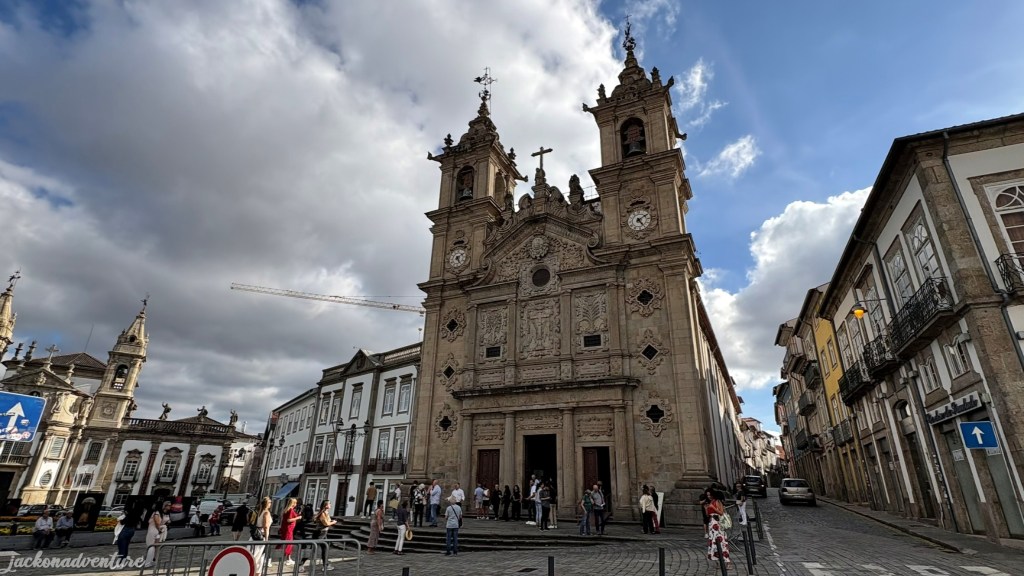
The Holy Cross Church was founded in 1625 under the Jesuit Order but was only completed until 1737. Also known as Igreja de Santa Cruz, the Mannerist and Baroque-style building is dedicated to the Holy Cross and forms part of the larger complex of the College for Philosophy and Theology.
The main altar is richly decorated with gilded woodwork that depicts scenes from Christ’s Passion, and is surrounded by figures representing Faith, Hope, Charity, Justice and Fortitude. The stunning azulejo tile panels illustrating biblical stories line the sides of the nave, with more depth to this spiritual journey.
As the legend goes, those who can spot the two roosters on the façade are said to marry within the same year. Since the Portuguese are quite religious, they come here to look for answers to their most sacred wishes.
During the Holy Week, the church hosts numerous processions and rituals.
Location: Largo Carlos Amarante 11, 4700-308 Braga
Opening Hours: Daily from 9.30 am to 1 pm and 3 pm to 7 pm
Entrance Fee: Free
Enjoy the scene of the beautiful Igreja de São Marcos

Designed by Carlos Amarante, the Hospital and the Church of São Marcos were built in the 18th century on the site of an old hermitage in honor of the saint. It later served as a hostel and convent associated with the Order of the Templars.
The church houses relics of San Marcos from the 12th century, given by The Great Templar Master Gualdim Pais. The façade of the complex is characterized by the Portuguese Baroque elements with Rococo influences. The life-sized statues of apostles and martyrs can be seen on the balustrade, and the composition is reinforced by its two bell towers to distinguish it from the hospital buildings of the era.
The remains of Diogo de Sousa, the founder of the hospital, are located in the main chapel of the church. In front of the complex is the Praca do Carlos Amarante.
Location: R. de São Bentinho 21, 4700-327 Braga
Opening Hours: Monday to Friday: 9.15 am to 4.30 pm/ Sunday: 10.15 am to 11.15 am
Entrance Fee: Free
View the grand Theatre Circo
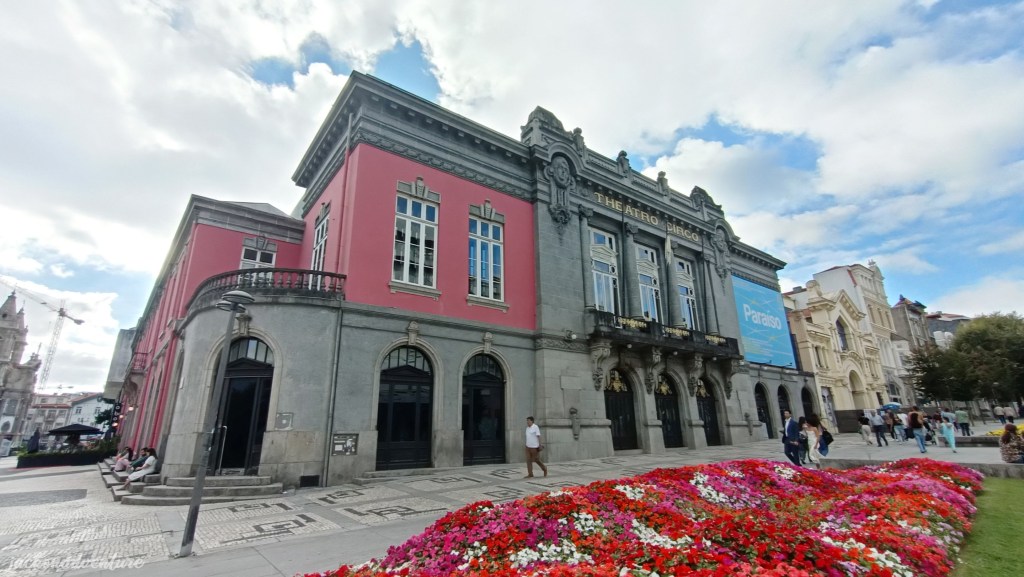
Opened in 1915, the Theatre Circo is a spectacular icon designed by the architect João de Moura Coutinho. The theatre retained much of its original form after a renovation in 1999. It currently hosts shows, festivals and cultural events. You can always tour the interior of the building if there are no events on the day.
Location: Av. da Liberdade 697, 4710-251 Braga
Relax at Chafariz do Castelo

The Chafariz do Castelo is an ornate fountain dating from 1723. It was erected under the orders of the Archbishop of Braga, Rodrigo de Moura Teles. The sculpture at the top of the fountain depicts a feminine figure regarded as a symbol of the city of Braga. It overlooks the Archbishop’s Palace, the rectory building of the Universidade do Minho and the Braga Public Library and Municipal Archive.
The six spouts of the fountain are shaped like a castle, hence the name. Beneath the structure is a group of classical putti supporting it. The statue of the female figure is topped with an iron armillary sphere under a patriarchal cross.
Location: Largo do Paço, 4700-314 Braga
Discover The Best of Portugal
Have you started falling in love with Portugal after learning how fascinating Braga is? Why not check out my posts on other cities and towns around the country with diverse histories and cultures:
Like It? Pin This Article.


 Jack on Adventure
Leave a comment